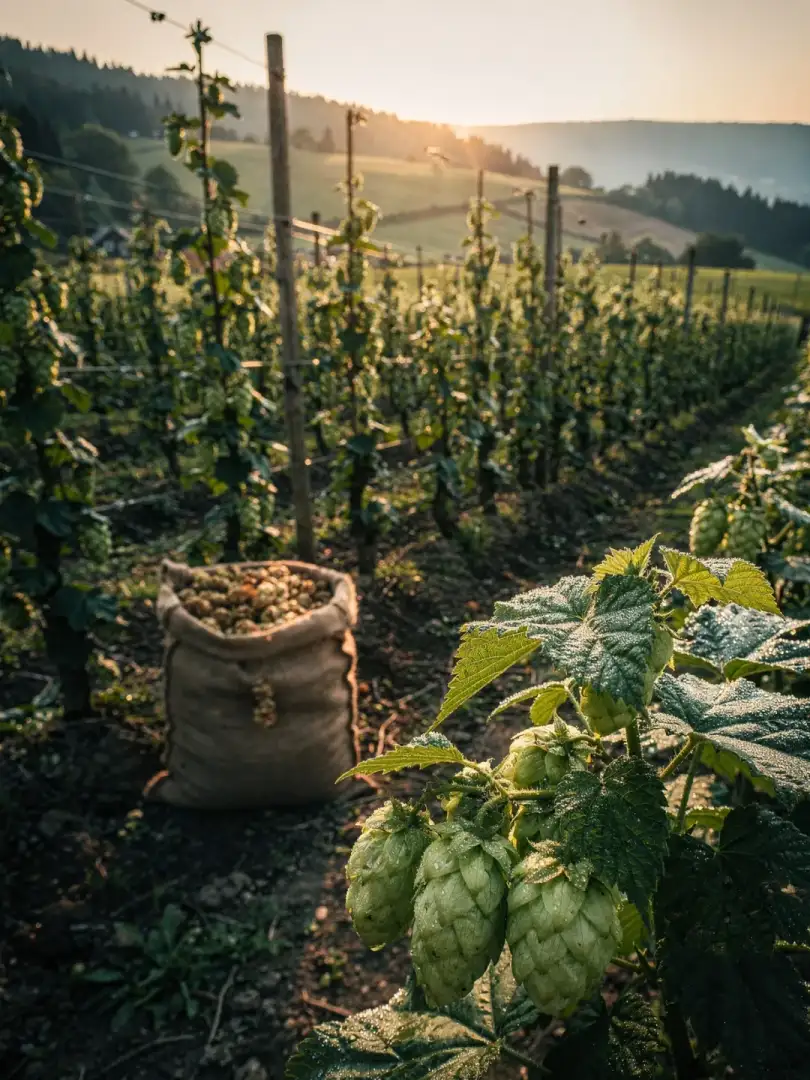
Hallertau, Slovenia, Alsace
Hops
No hops for Orval grow in the Gaume. The brewery boils its wort with hops from Germany and Slovenia, specifically Hallertauer, Styrian Goldings, and Strisselspalt. Hops are beer's seasoning plant, providing bitterness, aroma, and shelf stability.
The Hallertau region in Bavaria is the largest contiguous hop-growing area in the world, and 'Hopfen aus der Hallertau' has been protected as a PGI since 2010. Styrian Goldings grow in Slovenian Styria, in the Savinja Valley. The name Štajerski hmelj has been registered as a PGI since 2017. Strisselspalt comes from Alsace.
The three varieties work together in the brew kettle. All are considered fine aroma varieties, bringing floral, spicy, and slightly earthy notes. They give Orval a bitterness that, according to the brewery, reaches around 50 IBU. IBU is the unit for measuring bitterness, with a pilsner often landing between 25 and 40.
The real distinctiveness comes later. During maturation, the brewery hangs bags of whole hop cones in the beer for two to three weeks. This dry-hopping draws out fresh aromas rather than bitterness, since the hops are never boiled again. The cone's aromatic notes remain unspoiled and meet the earthy character of the wild yeast in the glass.
Bitterness and aroma are thus two separate tasks. Bitterness forms during boiling, as hop acids transform and dissolve into the beer. The aroma comes from essential oils that would evaporate during boiling and are therefore added only after fermentation. Orval uses both methods and gives hops far more room in this beer than in a Dubbel or Tripel.