Cold, Slow, Unfiltered
Yeast & Fermentation
In the cellar, the yeast works slowly. Most beers in the region are bottom-fermented, meaning the yeast sinks to the bottom after fermentation and ferments at low temperatures, roughly between 8 and 12°C (46–54°F). This takes longer than wheat beer fermentation but yields a calm, clean beer.
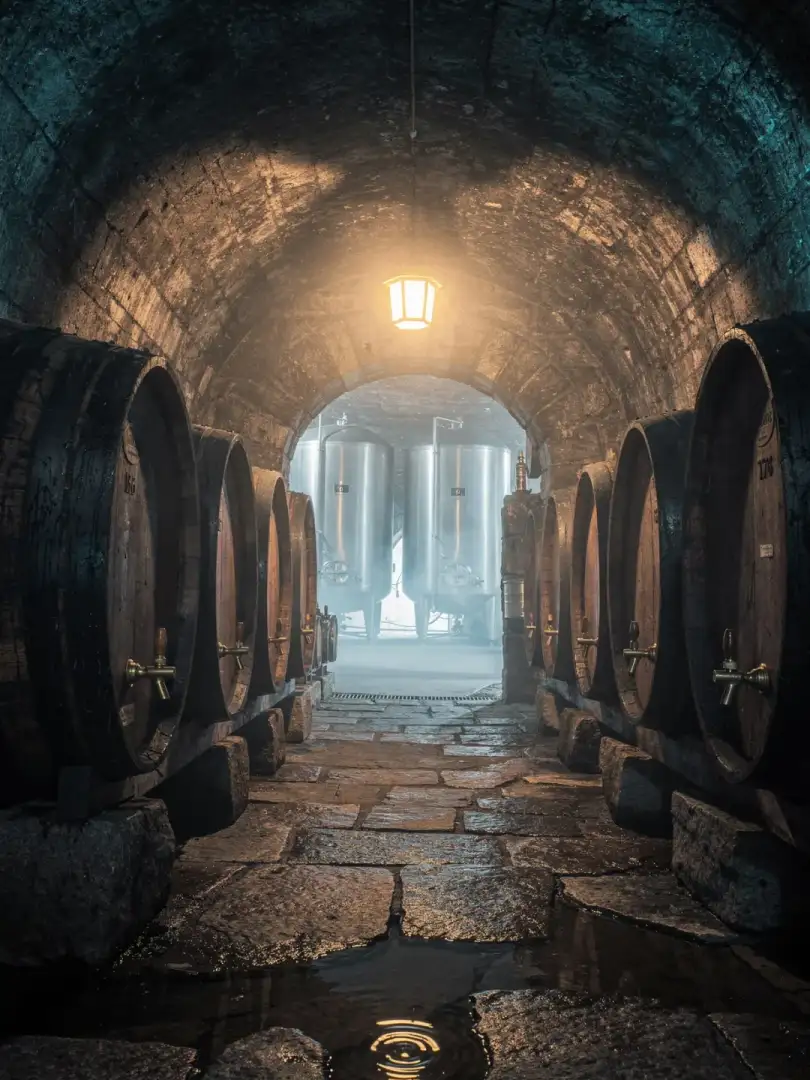
Afterward, the beer lagers, meaning it matures without further vigorous fermentation. Traditionally, Kellerbier was placed in the rock cellars at the end of the brewing season in March and stayed fresh there through summer. The cold of the stone did what refrigeration does today.
Unlike a Pils, Kellerbier is often left unfiltered. The yeast and fine protein particles remain in the glass, giving the beer a naturally hazy appearance and a somewhat rounder, breadier flavor. It also typically contains less carbonation, which is why the head is smaller.
A sample drawn from the cask before filtering is called Zwickelbier, named after the Zwickelhahn, the tap the brewmaster used to draw it. In everyday language, the words Kellerbier and Zwickel are often used interchangeably, even though, strictly speaking, Zwickel refers specifically to the sample.
Top-fermented beers, fermented at higher temperatures, are limited here to the wheat beers, such as the "Karpfen Weisse" from Herzogenaurach. For a long time, brewers didn't know that yeast was a living organism. Still, it was always present in the brew, carried over as sediment from the previous batch. It wasn't until 1883 that Emil Christian Hansen in Copenhagen succeeded in isolating and cultivating a single pure strain of bottom-fermenting yeast, and since then beers have become far more consistent from brewery to brewery.