Aroma from Elsewhere
Hops
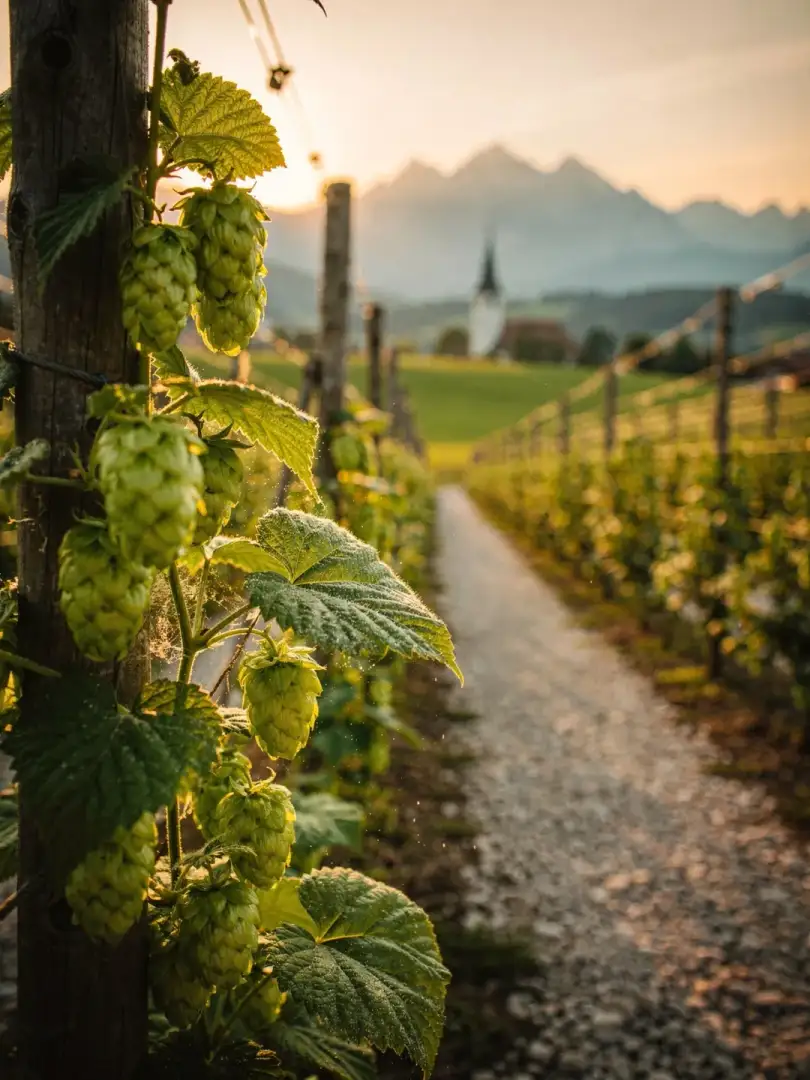
A hop garden isn't part of the Allgäu's landscape—its hops come from outside the region. The nearest major growing areas are Tettnang on Lake Constance and the Hallertau in Upper Bavaria. Both have carried a protected geographical indication since 2010. Which exact variety goes into any given beer rarely appears on the label.
Hops deliver two things. Bitter compounds, extracted from the cones during the long boil, balance out the malt's sweetness. Aromatic oils, by contrast, evaporate during a long boil, which is why aroma hops go in late. Bitterness is measured in IBU, a scale based on the concentration of bittering compounds.
For a Helles, bitterness stays low. The style guidelines from the BJCP beer judging association list 16 to 22 IBU; a pale wheat beer sits even lower, at 8 to 15. Anyone coming from a heavily hopped Pils will find both styles mild by comparison.
The aroma stays subtle—floral or lightly herbal, with a hint of hay and blossom. Hops are meant to round the beer out dry rather than color its flavor, and in wheat beer they fade almost entirely behind the banana and clove notes. In a Helles especially, which has almost nothing to hide behind, every flaw shows.
Whether it's Allgäuer Brauhaus in Kempten, Zötler in Rettenberg, or Härle in Leutkirch: all three buy in their hops. They arrive dried, usually pressed into pellets, and are stored cool, since both aroma and bitterness fade over time.