Barley from the Neighbors
Malt & Grain
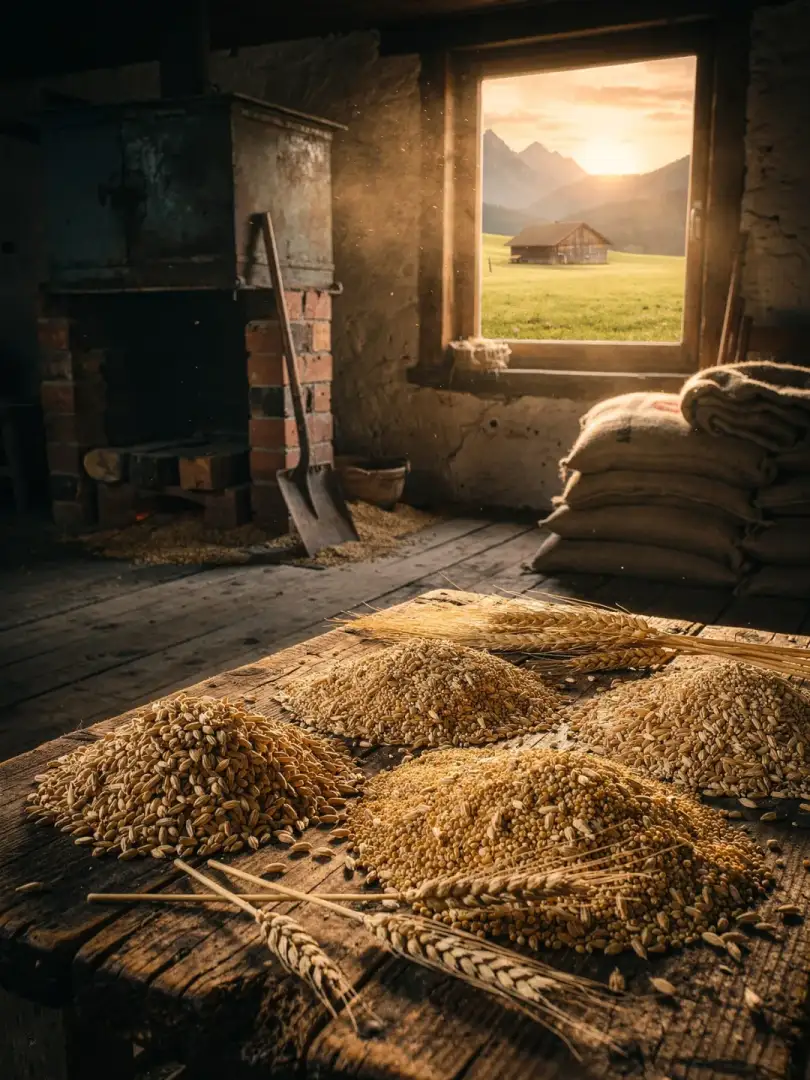
The Allgäu is dairy country, not grain country. Grass grows on its meadows and pastures, and breweries buy in their barley, mostly from Bavaria and Swabia. The grain is turned into malt at maltings: the kernels are briefly allowed to germinate so their starch can convert into fermentable sugar, then drying halts the germination.
This drying is called kilning, and it determines the color. For a Helles, the malt is kilned gently and pale, giving it flavors of bread crust and honey. For a Dunkel, the kiln runs hotter and longer, producing roasted notes reminiscent of bread and caramel. Smoked malt, as used in Bamberg, plays no role in the Allgäu.
Wheat malt joins the mix for wheat beer. The industry rule of thumb calls for a share of at least half, though I found no legal requirement specifying this. The wheat gives the beer its soft, slightly creamy character and supplies the protein that supports its dense foam.
In Bavaria, even top-fermented beer may contain only malt, hops, yeast and water. The Reinheitsgebot of 1516 originally named just barley, hops and water—yeast was added to the rule only later. In Leutkirch, on the Württemberg side, Bavaria's sugar rule doesn't apply, though the Reinheitsgebot still governs bottom-fermented beers there.
In the brewhouse at Allgäuer Brauhaus in Kempten, as at Härle in Leutkirch, the work begins by crushing the malt and mashing it in with warm water. This releases sugars and flavors from the grain, turning the mash into the sweet wort that will later be fermented.