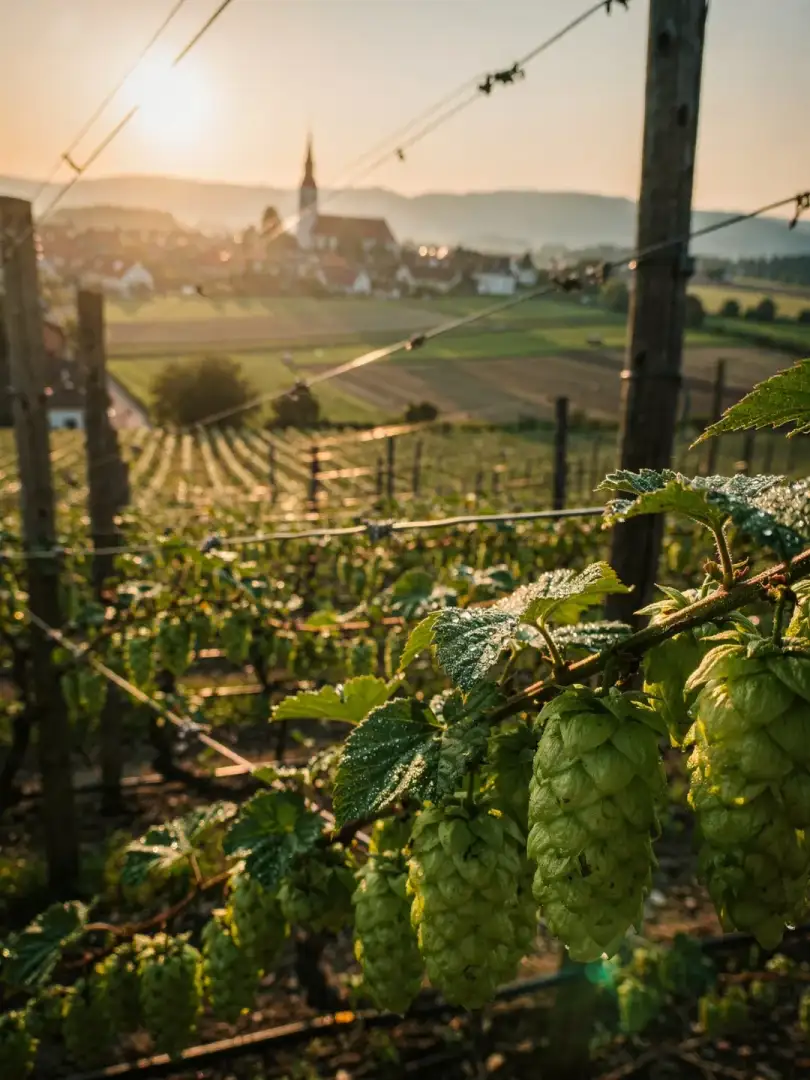
From the Hallertau
Hops
Little hops grow in the Oberland itself. Ayinger says it sources its hops exclusively from the Hallertau, the large growing region northeast of Munich. On the way there, you cross the Isar and the Munich plain; from Aying, the Hallertau isn't far.
Hops give beer two things. Their bittering compounds balance the malt's sweetness, while their oils bring aroma, perhaps of hay, herbs or blossoms. The earlier the hops go into the boil, the more bitterness results; the later, the more aroma.
In a Helles, the hops stay deliberately in the background. It tastes only lightly bitter, never harsh, with the hops acting more like a subtle spice. In the Jahrhundert-Bier, first brewed for the brewery's 100th anniversary, tasters instead describe a spicy bitterness up front.
Hops from the Hallertau carry the PGI seal "Hopfen aus der Hallertau" (since 2010). Which varieties shape any particular Oberland beer is usually not disclosed by the breweries, so we'll spare you variety names here.
How the hops enter the boil matters almost as much as where they come from. The cones are usually dried and pressed into pellets, which store more easily. The wort is boiled with the hops for about an hour, releasing the bittering compounds. A small portion goes in just before the end, so its aroma doesn't boil off. This late addition brings floral and herbal notes without raising the bitterness, and that's exactly what the Oberland Helles aims for: spice rather than sharpness.