Deep Wells and Tuff Cellars
Water & Soil
Where does Ayinger's brewing water come from? According to the brewery, from a well roughly 176 meters deep right next to the brewhouse. It's rich in carbonates, meaning dissolved calcium salts that push the pH upward during mashing.
This suits dark malt, which brings its own acidity to balance the carbonate. For pale beers, brewers often soften the water so the hops don't come across harsh. Nearly all breweries treat their water today anyway, so the rule is: water explains the character, but no longer determines it alone.
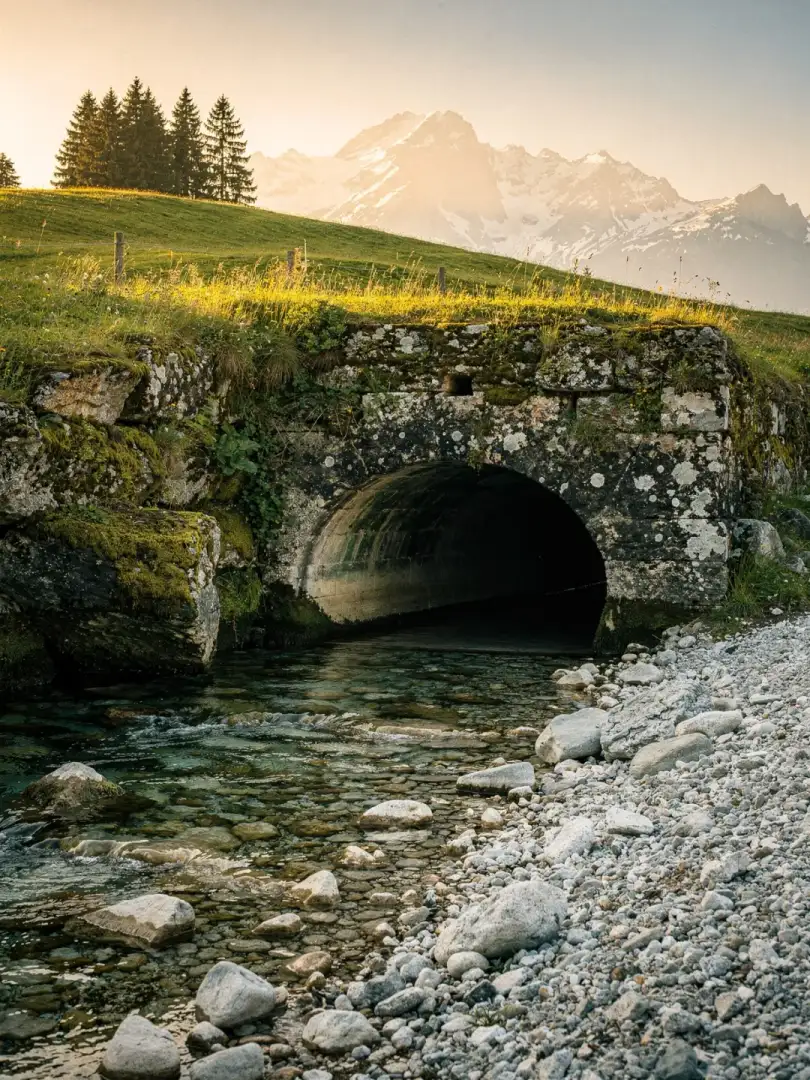
The soil around Aying belongs to the Munich gravel plain, a bed of gravel deposited by Ice Age debris from the Alps. Further south, the land rises into moraine hills, moors and lakes, and beyond that the mountains begin. Rain and meltwater seep through the gravel and fill deep aquifers.
For flavor, this means water from great depth is cool, clear and consistently composed, unaffected by weather. That matters to brewers who want every batch to taste the same. We won't cite specific hardness levels, since breweries don't publish them uniformly and the water is often treated anyway.
In Bad Tölz, brewers made use of a different quirk of the ground. They stored their beer in cellars cut into the tuff stone at Mühlfeld, where it stayed fresh even in summer. The climate at the edge of the Alps, with cool nights and autumn foehn winds, long made such cellars the area's most important cooling device.