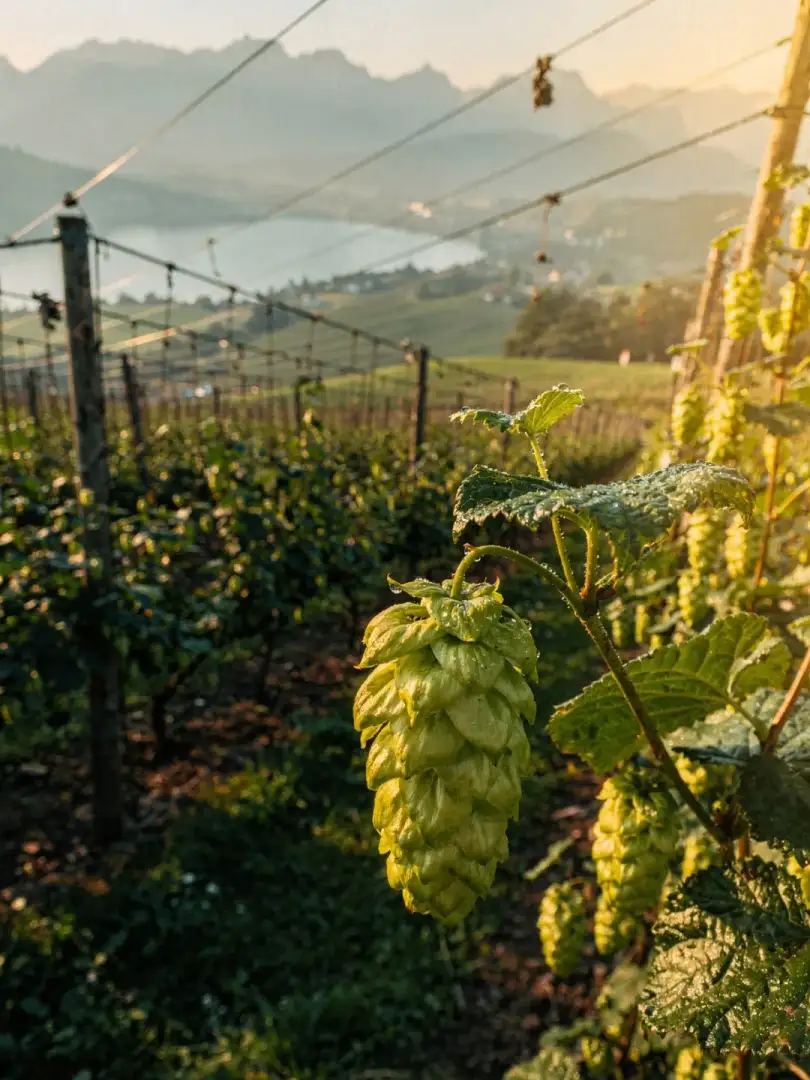
Sourced from Tettnang
Hops
Does hops grow in Baden? There's no notable growing region here, so breweries buy their hops in. Germany's major hop-growing areas lie elsewhere. In 2025, Germany had about 18,962 hectares under cultivation, with the Hallertau in Bavaria alone accounting for roughly 17,129. The nearest source for Baden's brewers is Tettnang on Lake Constance.
Hoepfner brewery names precisely these two regions as the source of its aroma hops: Tettnang and the Hallertau. Tettnang hops have carried the EU's protected geographical indication since 2010. Typical varieties include Tettnanger and, from the Hallertau, Hallertauer Mittelfrüh, both considered aroma hops. Their scent evokes herbs, hay, and blossoms.
Hops serve two purposes in beer. The bittering compounds, the alpha acids, balance the sweetness of the malt. The essential oils provide aroma. Bitterness is measured in IBU, International Bitterness Units. A German Pils falls between 22 and 40 IBU, a Hefeweizen only between 8 and 15, since there the bitterness should take a back seat to the yeast's fruity character.
Bittering hops and aroma hops often go into the kettle separately. The bittering hops are boiled with the wort for a long time so their acids can dissolve. The delicate aroma hops are added only near the end of the boil, so their fragrance doesn't dissipate. This is how each brewery gives its Pils a distinct balance, even when both draw hops from the same Hallertau or Tettnang sources. Exactly how much hop each brewery in Karlsruhe, Plankstadt, or Heidelberg uses remains a trade secret.