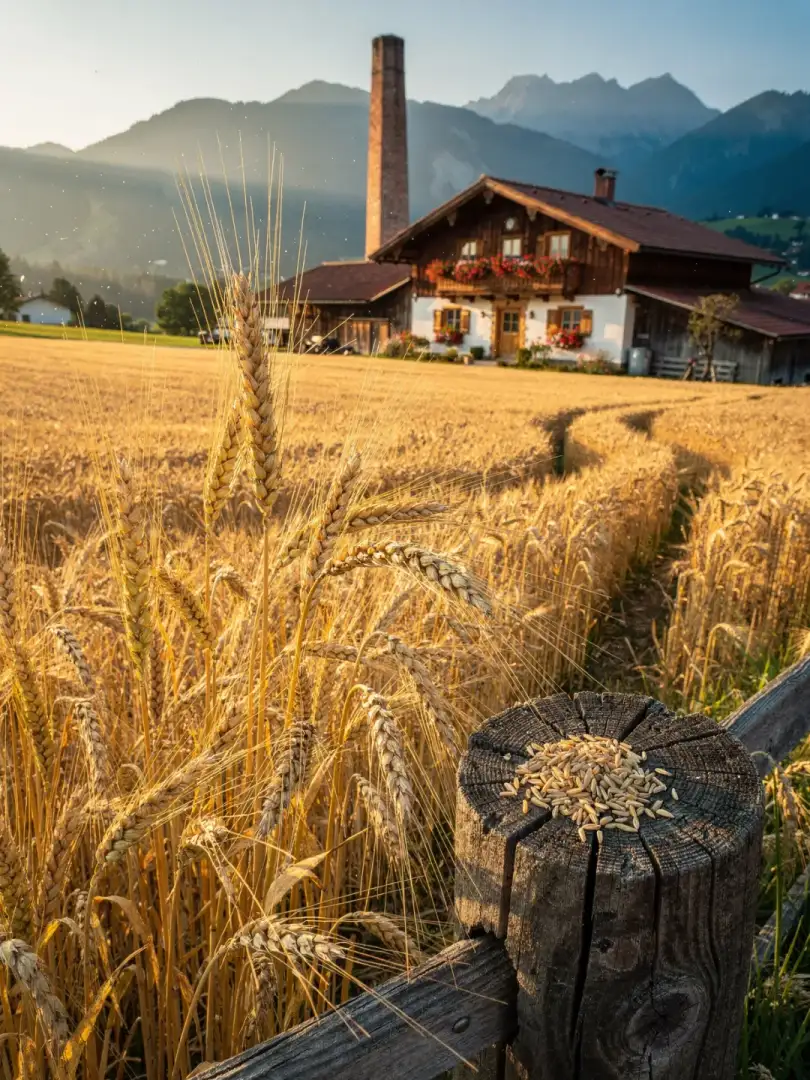
Wheat and Barley
Malt & Grain
Weissbier from the Chiemgau starts with wheat. To make wheat malt, the grain is first allowed to germinate and is then dried; for Weissbier, it's blended with barley malt. Industry convention holds that at least half the grist should be wheat malt. This share gives the beer its soft, bready fullness and dense head.
Barley forms the second pillar, especially for Helles and Bock. It provides the clean malt sweetness that carries a Helles. How light or dark the beer turns out depends on the kiln, the oven in which the germinated grain is dried: the longer and hotter the kilning, the darker and toastier the malt.
For a Dunkles or a dark Bock, malt from the hotter kiln goes into the mash, contributing notes of bread crust and caramel. Lightly kilned malt, on the other hand, yields a straw-yellow Weissbier with a mild grain character.
In Bavaria, the Reinheitsgebot (purity law) is enforced more strictly than in the rest of Germany. For top-fermented beers, other malts and sugar are permitted elsewhere, but in Bavaria sugar is banned even in Weissbier. A Chiemgau Weissbier therefore consists of wheat malt, barley malt, hops, yeast, and water — nothing more.
Hofbräuhaus Traunstein and Wieninger Teisendorf both brew according to the Bavarian purity law, so their Weissbier likewise consists only of malt, hops, yeast, and water. Which maltings supply each brewery is disclosed by the companies themselves, so nothing definitive can be said here. What's certain is that the grain grows in the Alpine foothills, where the farmland between Lake Chiemsee and the Salzach is shaped by meadows and fields.