Bitterness in Bock
Hops
How bitter is bock beer? Less than you'd expect from such a strong beer. By competition judging standards, a pale bock runs about 23 to 35 IBU, a dark bock about 20 to 27. IBU is the measure of bitterness: the higher the number, the sharper the beer. For comparison, a German Pilsner sits at 22 to 40.
The reason lies in the malt. A bock brings so much sweetness that the hops are meant only to balance it, not to overpower it. This makes the beer taste rounder rather than sharp, with the hops staying in the background.
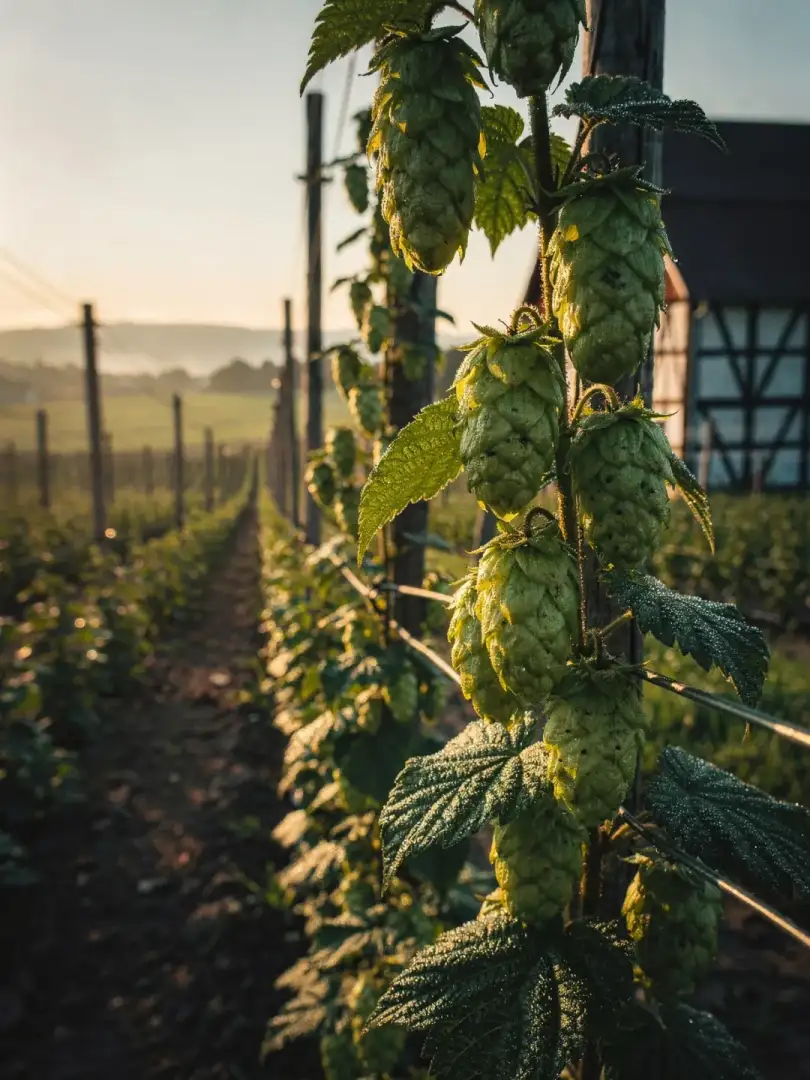
No significant hop growing is documented here. Hop gardens with their tall trellises don't define this landscape; Germany's major growing regions lie elsewhere. These include the Hallertau and the area around Tettnang, both of which have held EU protected geographical indication status since 2010, along with the Elbe-Saale region. Which regions and varieties Einbecker Brauhaus hops with is best answered by the brewery itself.
Hops serve two roles in beer. First, they supply bittering compounds that dissolve during the wort boil, and second, aromatic oils that survive late additions. They also act as a preservative. That's exactly what helped Einbecker beer on its long journeys: a strongly brewed, well-hopped beer held up better aboard Hanseatic cargo ships than a weak brew would.
In bock, hop aromas are deliberately kept in check. Those looking for them will find light herbal spice or a hint of grass, but nothing like the citrus or fruit bomb of an IPA.