Jurassic Rock and Springs
Water & Soil
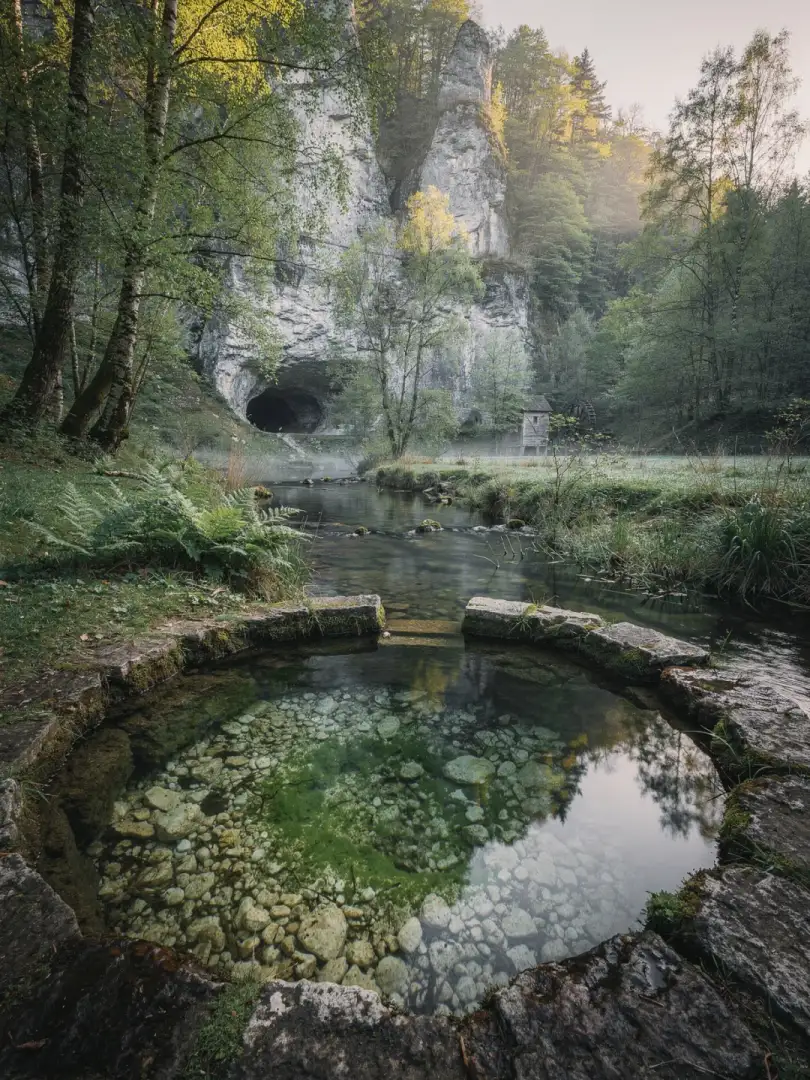
Beneath the high plateaus of Franconian Switzerland lies Jurassic limestone, riddled with holes like Swiss cheese. Rain seeps in, travels through fissures and caves, and re-emerges in the valleys. The Wiesent and Trubach rivers collect this water, and villages like Aufseß, Gräfenberg, and Thuisbrunn grew up around these springs.
What this has to do with beer becomes clear once you look at the rock itself. Limestone lends the water carbonate hardness, dissolved from the stone. Carbonate-rich water traditionally suits darker malts, while very soft water, as in Pilsen, favors the pale, sharply hopped Pils style.
That doesn't mean every Seidla tastes of rock. As everywhere, nearly all breweries today treat their water, and the small operations in the region are best placed to describe their own wells and springs. So the soil shapes the character of the landscape more than it shows up in measurable terms in the glass.
More significant is what the rock offers above and below ground. The stone could be carved into cellars that stay cool in summer and frost-free in winter. Where cliff faces stand close to a village, the beer cellars sit right behind them, and some innkeepers stored their beer there until it was ready to be served.
Then there's the climate. The high plateaus are harsher than the Regnitz valley, and the valleys themselves are shady and damp. That's exactly what the old brewers wanted: cool air for the fermentation cellar, ice from the ponds in winter, and stone that kept summer's heat outside.