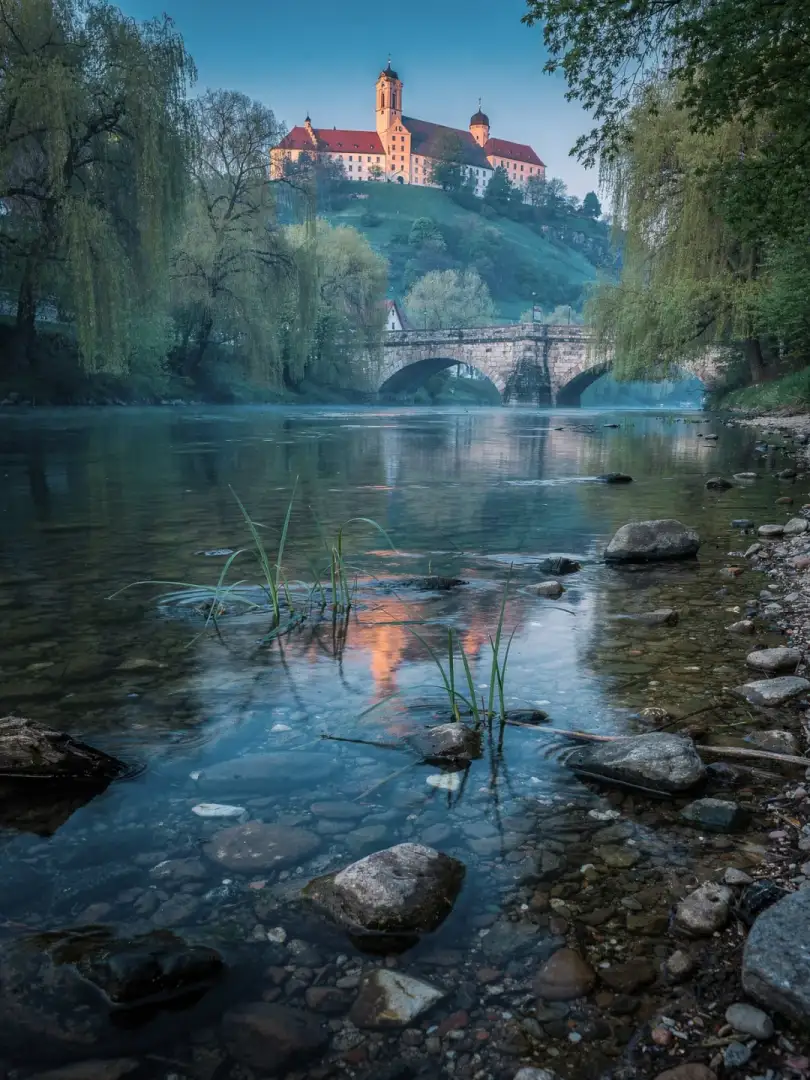
The Isar and the Hills
Water & Soil
Freising lies where the Isar leaves the Munich area and turns toward Landshut between hills and moorland. The old town with its cathedral sits atop the Domberg, the Weihenstephaner Berg rises opposite it, and the Moosach stream runs along the slope. Two hills, one river: that's all the picture needs.
This guide doesn't cite specific hardness figures for Freising's brewing water, since reliable, up-to-date analyses aren't available. What is clear is true for the whole region, and the entire Alpine foreland: the water is calcareous and thus tends to be rich in carbonates, much as it is in the Munich area.
For a Weißbier, this matters less than it would for a Pils. Carbonate raises the pH of the mash, which suits darker malts that bring their own acidity. For a pale Hefeweizen, the wheat malt and yeast matter far more than the water.
Nowadays, nearly every brewery treats its water, whether through softening, salts, or acid. The idea that water alone defines a style belongs to history, not the present. A brewery based at a university, of all places, measures and adjusts rather than relying on the ground beneath it.
Still, the hill matters to the beer as a place, not as a water source. In the Middle Ages, the hill offered cool storage, and the view across the Isar valley is a reminder that farming, brewing, and research have always been neighbors here.