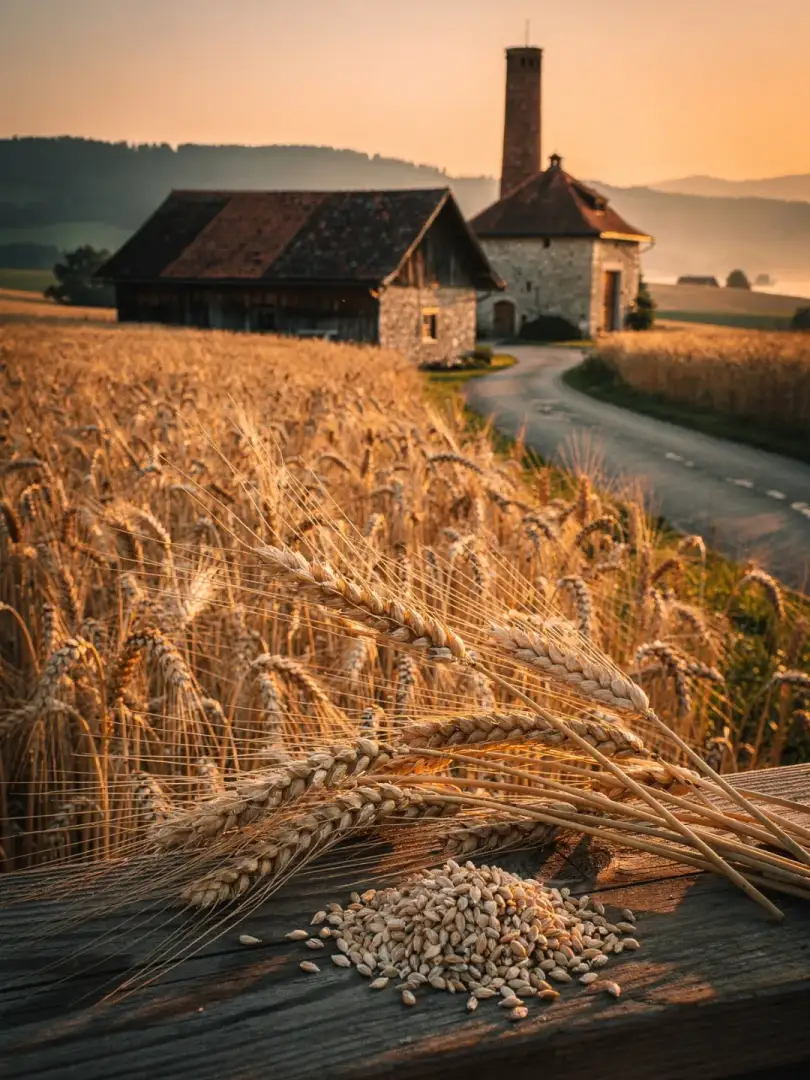
Wheat Without Husks
Malt & Grain
What is wheat malt, and why does Weißbier need it? Like barley, wheat is germinated and then dried in the kiln, the malthouse's oven. Weißbier is made largely from wheat malt; the common industry rule calls for at least half. This rule is considered a rule of thumb in the trade.
The rest is barley malt. For a pale Weißbier it's pale malt; for a dark Weizen, darker roasted portions are added. Wheat tastes bready and slightly tangy, and it makes the foam firmer and the beer hazier, since more protein stays in the glass.
For the brewer, wheat has a catch. Barley keeps its husks, the hard outer shells, after threshing, and these husks form a filter bed during lautering. Lautering means separating the wort from the spent grain. Wheat has no husks, so the wort drains more sluggishly—one reason Weißbier brewers blend barley with wheat.
In Bavaria, the Purity Law also applies to top-fermented beers without sugar. Unlike in the rest of Germany, no added sugar is allowed in the brew here, a rule in place since 1924. The Weißbier from Freising is therefore pure malt extract, with no smoke, no spices, and no corn.
The Gräfliches Hofbrauhaus Freising states that it brews with malt from Bavaria, and the Bayerische Staatsbrauerei Weihenstephan relies on the same trio of wheat, barley, and water for its Hefeweißbier that brewers have known for centuries. In the Hefeweißbier, the wheat takes center stage; for the Vitus, with its higher original gravity, correspondingly more malt goes into the kettle. We haven't been able to verify exactly which maltings supply the grain, so we won't name any here.