Cones & Varieties
Hops
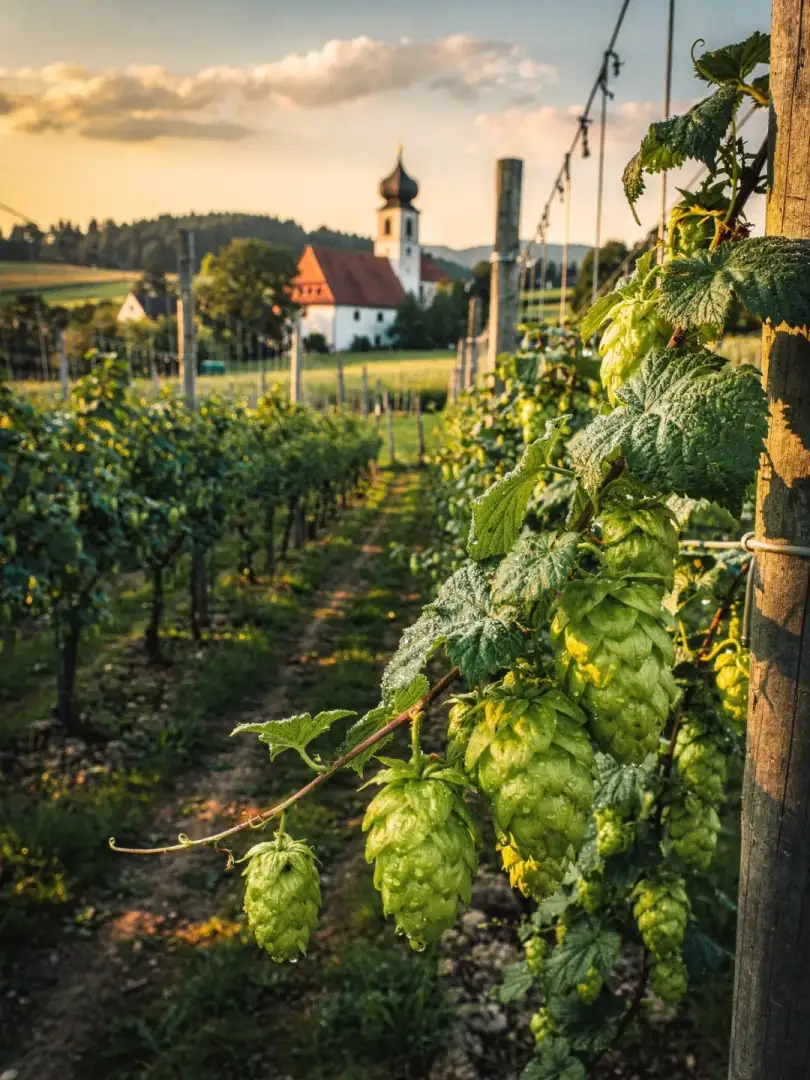
Hops grow on wires hung from tall frames, their vines twisting clockwise as they climb. Only the female plants bear the cones that later go into beer. Inside the cones sit small yellow glands containing bittering compounds and essential oils.
The bittering compounds, the alpha acids, make beer bitter. The oils provide aroma, ranging from hay and herbs to flowers to citrus and mandarin. That's why hops are divided into bittering hops with high alpha acid and aroma hops with delicate oil.
In Germany in 2025, hops were grown on 18,962 hectares, the vast majority of it in the Hallertau. The most common variety was Herkules, a bittering hop, on 7,848 hectares, accounting for 39 percent of Germany's hop acreage. Next came the aroma varieties Perle with 2,343 hectares and Hallertauer Tradition with 2,017 hectares.
The figures show a shift. Perle and Tradition each lost around 18 percent of their acreage in 2025, while the new high-alpha variety Titan grew by 74 percent to 560 hectares. The trend is moving away from aroma hops and toward bittering hops.
The classic aroma variety is called Hallertauer Mittelfrüh. Newer breeds such as Mandarina Bavaria are meant to taste fruitier, and a dedicated research station in Hüll near Wolnzach works on developing new varieties.
Harvest runs from late August to late September, each variety at its own time. Machines separate the cones from the vines, after which the hop kiln dries them; they rest briefly and are then pressed into bales. Hop picking used to be done by hand; today some farms invite guests to help pick.