Boiling & Dry Hopping
Yeast & Fermentation
Hops enter the beer twice, and yeast is involved both times. When the wort — the sugary liquid made from malt and water — is boiled, the hops release their bitterness. Afterward it goes into the fermentation tank, where yeast converts the sugar into alcohol and carbon dioxide.
Hopping early in the boil mainly yields bitterness, since alpha acids only dissolve through prolonged heat. Hopping late preserves more aroma, because the oils evaporate over time. Many breweries therefore split their hop additions across several stages.
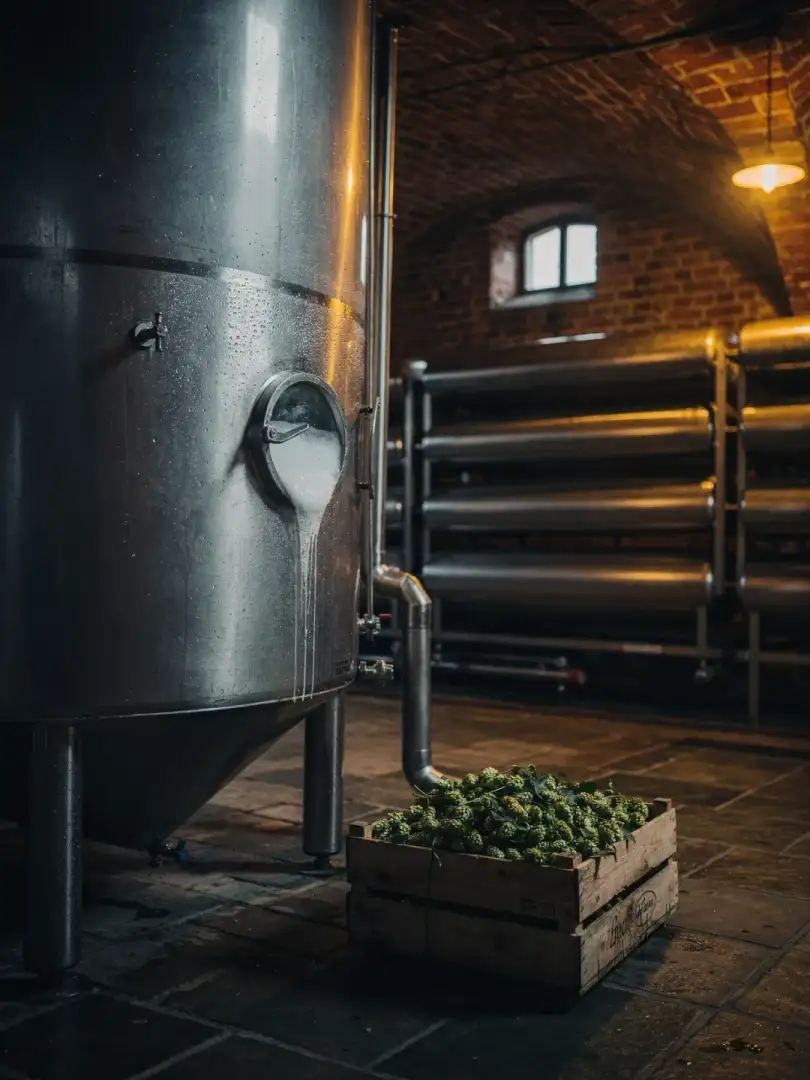
With cold hopping, or dry hopping, hops are added cold to the fermenter or the lagering tank. This creates aroma without additional bitterness. Those who want hops to be the main character use this method, and it suits a land where the hops grow right outside the brewery.
Hops also protect beer from certain microbes, which was important for shelf life in the past. That yeast belongs in beer was only explicitly written into Bavarian law in 1910, even though it had long been part of brewing.
The Hallertau's flagship beers ferment bottom-fermented, meaning with yeast that works at low temperatures and settles at the bottom after fermentation. Roughly eight to twelve degrees Celsius is common for primary fermentation, followed by several weeks of lagering at just a few degrees above freezing. The result is a clear, calm beer.
Weissbier works differently: it ferments top-fermented and warmer, and the yeast stays in the glass. A well-known example from the area is the Kuchlbauer brewery in Abensberg, on the edge of the Hallertau. So part of the journey is also this contrast between cold and clear, and warm and cloudy. That the hops for it might come from Mainburg or Wolnzach changes nothing about the fermentation.