Smell Before You Drink
Tasting
What does hops from the Hallertau taste like? The best way to check is with your nose before you drink: tilt the glass, swirl it briefly and inhale. With classic aroma varieties you'll find hay, herbs and flowers; with newer varieties, citrus or mandarin.
The bitterness shows itself with the first sip. It sits at the back of the tongue and lingers after swallowing. In a Helles you'll barely notice it there, in a Pils clearly so, while a Weissbier presents fruit and spice ahead of it.
Breweries from the area serve as examples, with their beers' details available on the label according to the brewery. Ziegler Bräu in Mainburg is a small family-run operation with a beer garden on the Salvatorberg. Schlossbrauerei Au-Hallertau cites a brewing tradition dating back to 1590, and Müllerbräu in Pfaffenhofen to more than 350 years.
On the edge of the Hallertau lies Abensberg, home to the Kuchlbauer brewery, known for Weissbier and a tower designed by the artist Friedensreich Hundertwasser. All four breweries stand on their own; there is no single shared Hallertau style.
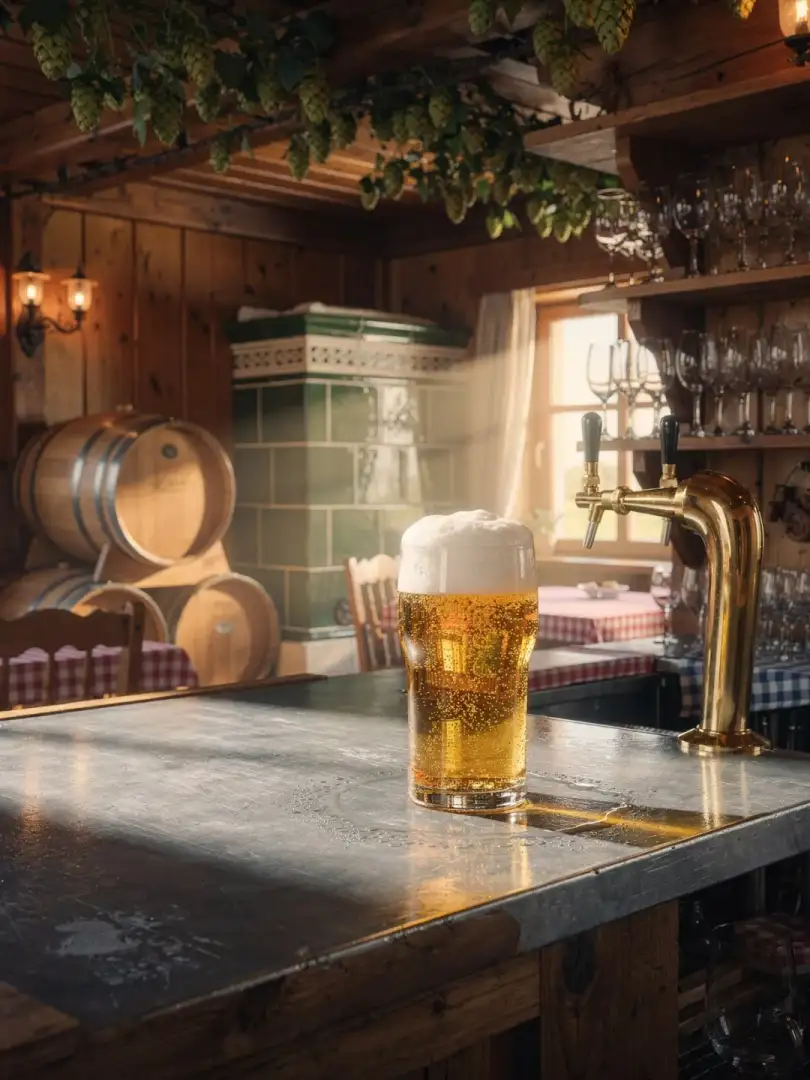
The glass depends on the beer. Pils tastes best in a slim Pils tulip or tulip glass, which holds the foam and concentrates the aroma. Helles suits a Seidel or a Maß, while Weissbier belongs in the tall, curved wheat beer glass.
Served cool, bitterness feels fresher; too cold, and the aroma disappears. Common serving temperatures for Pils and Helles are around six to eight degrees Celsius, similar for Weissbier. In the pub, pouring is handled by professionals; at home, a clean, wet glass filled at an angle helps.