Bought in, Not Picked Locally
Hops
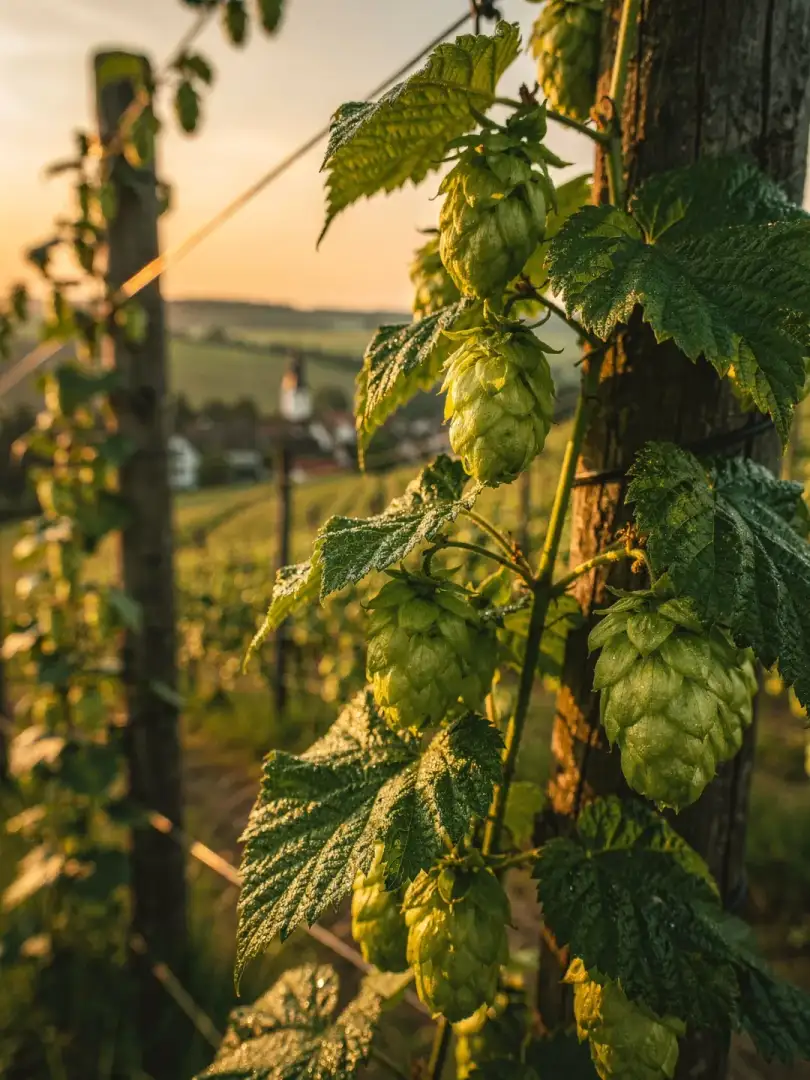
No hops of any note grow in Hesse. Germany's major growing regions lie elsewhere, above all the Hallertau in Bavaria with around 17,129 hectares, which is about 83 percent of Germany's total area of 18,962 hectares in 2025. The breweries in Lich, Frankfurt and the Mossautal therefore buy in their hops.
Which varieties go into a Hessian Pils? Exactly which ones, each brewery keeps to itself. For German Pils beers, varieties such as Perle, Tradition and Magnum are common, with Hallertauer Mittelfrüh considered a classic aroma hop. That is standard knowledge, not a statement about Licher or Schmucker specifically.
Hops serve two purposes. Added early in the boil, they mainly contribute bitterness that balances the sweet malt. Added late, they bring aromas of grass, herbs or blossom. Bitterness is measured in IBU, a scale for bittering units. For a German Pils, the range according to competition guidelines runs from 22 to 40.
Here it's worth looking at Apfelwein, which stands right in the middle of Frankfurt's beer territory. It contains no hops and no bitterness, but acidity and tannins from the apples. Anyone switching from Äppelwoi to Pils notices the difference immediately on the tongue, not in the alcohol.
The law also permits hop powder and hop extracts without the beer losing its designation. Whether a brewery uses whole cones, pressed pellets or extract is usually not stated on the label. Anyone who wants to know for certain should ask the brewery directly.