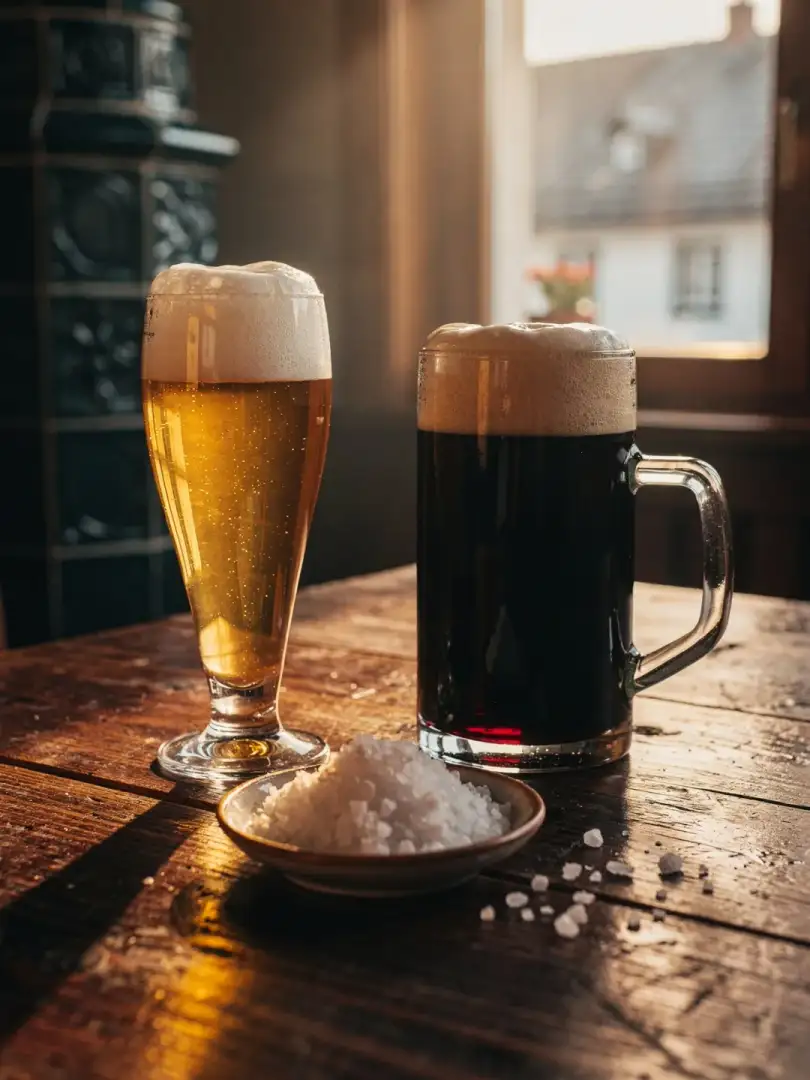
Pils, Dunkel, Schlappenbier
Beer Styles
What is Hofer Bier? It's not a beer style but a designation of origin. Under this name you'll find Schankbier, Eisbier, Helles, Pils, Export, Dunkel, Kellerbier, Märzen, Bock (pale and dark), Doppelbock, wheat beers, and Weizenbock. What they share is their place of origin, not a shared recipe. The strength of each beer is stated on the label, ranging according to the Genussportal from 2.7 to 8 percent ABV.
Three styles define everyday life in the region. Pils is the standard pub beer: pale, dry, with pronounced hop bitterness. Dunkel places Hof close to its neighbors, as Thuringia and Saxony—where Schwarzbier originated—begin just north of the town. Wheat beer rounds out the top-fermented side of the range.
What's the difference between Dunkel and Schwarzbier? Munich-style Dunkel is brown, malty, and slightly sweet, originating in Bavaria. Schwarzbier is nearly black, yet far from heavy—dry and lean, with roasted notes recalling cocoa and bread. Hof sits right on the border between these two worlds, and depending on the brewery, its dark beers can lean toward either style.
One special case is Schlappenbier. Scherdel brews it for Schlappentag at, according to the brewery, 6.5 percent alcohol, following the original recipe. It belongs to the category of strong festival beers and is brewed only for this occasion.
All ranges given below come from the BJCP 2021 style guidelines and represent competition parameters, not recipe requirements. Individual beers may fall outside these ranges; actual values are stated on the brewery's label.
Pils (German)bottom-fermented
- Original gravity
- 11–12.4 °P
- Alcohol
- 4.4–5.2 % vol
- Bitterness
- 22–40 IBU
- Colour
- 4–8 EBC
Pale gold, dry, clean hop bitterness, fine-pored white foam.