Pils, Dunkel, Strong Beer
Tasting
What does Hofer Bier taste like? Typical traits include a dry, cleanly built character without any sugary sweetness—pale styles show clear hop bitterness, while dark styles carry roasted notes. Tasting several varieties side by side reveals just how close Pils and Export are to one another in this region.
Four beers serve well as examples representative of the region. Scherdel's Pils showcases the pale, hoppy end of the spectrum. Meinel-Bräu's Kellerbier represents the unfiltered side, with a softer, breadier note. The same brewery's Dunkel shows the roasted side. Scherdel's Schlappenbier, stated by the brewery at 6.5 percent strength, is the region's festival beer and a seasonal example of a richer malt body.
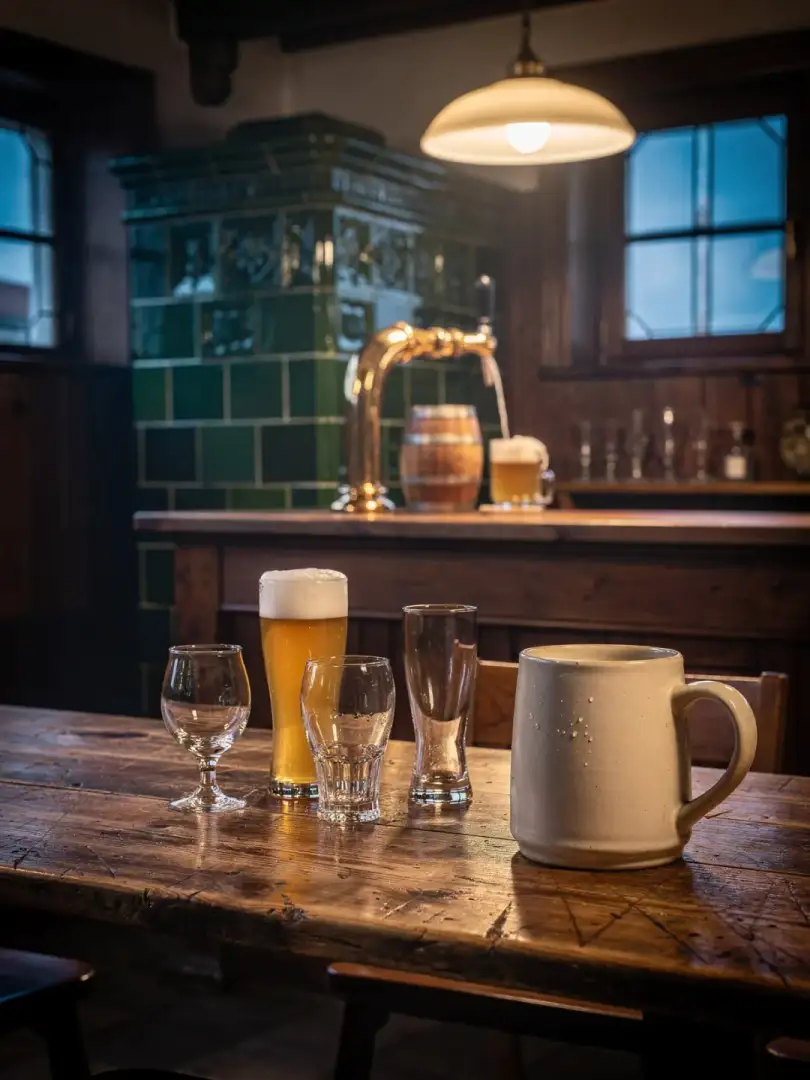
A slim tulip glass or a Pilsner glass suits Pils well, as it holds the foam and concentrates the aroma. Wheat beer belongs in the tall, flared Weizen glass. Dunkel and Märzen taste fine from a mug or tankard too, as long as the glass isn't ice-cold.
Pils is best enjoyed at around 6 to 8°C (43–46°F); Dunkel and strong beers can be served one or two degrees warmer so that roasted and malt aromas don't disappear in the cold. Wheat beer tolerates some chill, but not freezing temperatures.
Pouring calls for patience. Pils is poured in several stages until a firm head of foam forms, with brief pauses in between. The often-cited seven minutes is more a saying than a rule—actual pour time depends on the tap system, temperature, and carbonation.