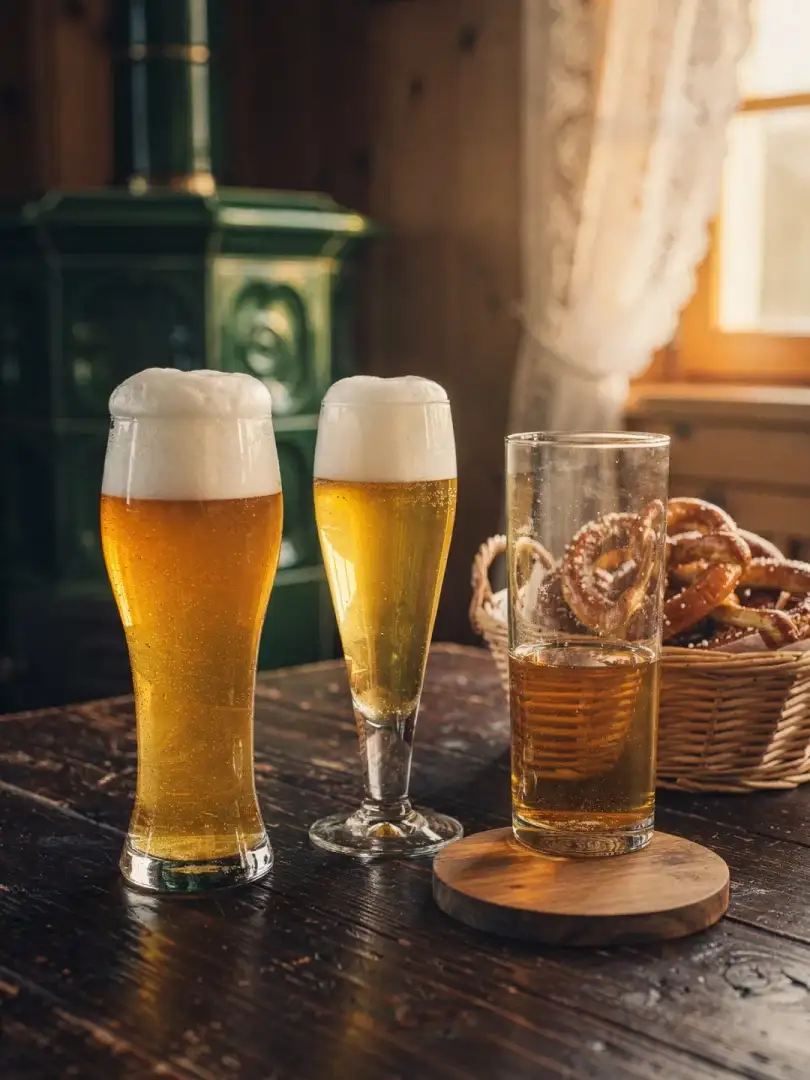
Helles, Pilsner, Weissbier
Beer Styles
A beer brewed according to the Reinheitsgebot is defined by a framework, not a specific style. Within that framework, Ingolstadt produces three flagship beers found in every tavern in town: Helles, Pilsner, and pale Weissbier. The figures below are competition ranges from the BJCP judging guidelines, not any single brewery's recipe.
Helles is golden, malty, and lightly hopped. Its original gravity—the dissolved sugar content before fermentation—typically sits around 11 to 12 degrees Plato. A Pilsner, by contrast, is drier and more bitter, and in Germany it's a generic style name, not a brand.
Pale Weissbier differs from both through its top-fermenting yeast. It tastes of banana, clove, and fresh bread, and it's usually cloudy, since the yeast remains in the glass. Filtered, it's called Kristallweizen. And for Bavaria, the same rule applies to Weissbier as to everything else: no sugar.
A side-by-side comparison quickly reveals the difference between fermentation method and style. Helles and Pilsner are bottom-fermented and clear; Weissbier is top-fermented and cloudy. All three can claim the Reinheitsgebot, yet they taste completely different.
All three can be found around the city. Herrnbräu offers pale Weissbier as Hefeweißbier Hell and bottom-fermented Pilsner as Premium Pils, while Nordbräu's range includes Pilsner, Helles, and Kellerbier. Kellerbier isn't its own separate category—it's a Helles or Märzen served unfiltered and naturally cloudy. Tasting all three fermentation styles side by side is the quickest way to understand what the Reinheitsgebot allows, and just how much room it leaves for variety.
Hellesbottom-fermented
- Original gravity
- 11–11.9 °P
- Alcohol
- 4.7–5.4 % vol
- Bitterness
- 16–22 IBU
- Colour
- 6–10 EBC
Golden yellow, soft malt character, lightly hopped, clear.