Missing from the Text
Yeast & Fermentation
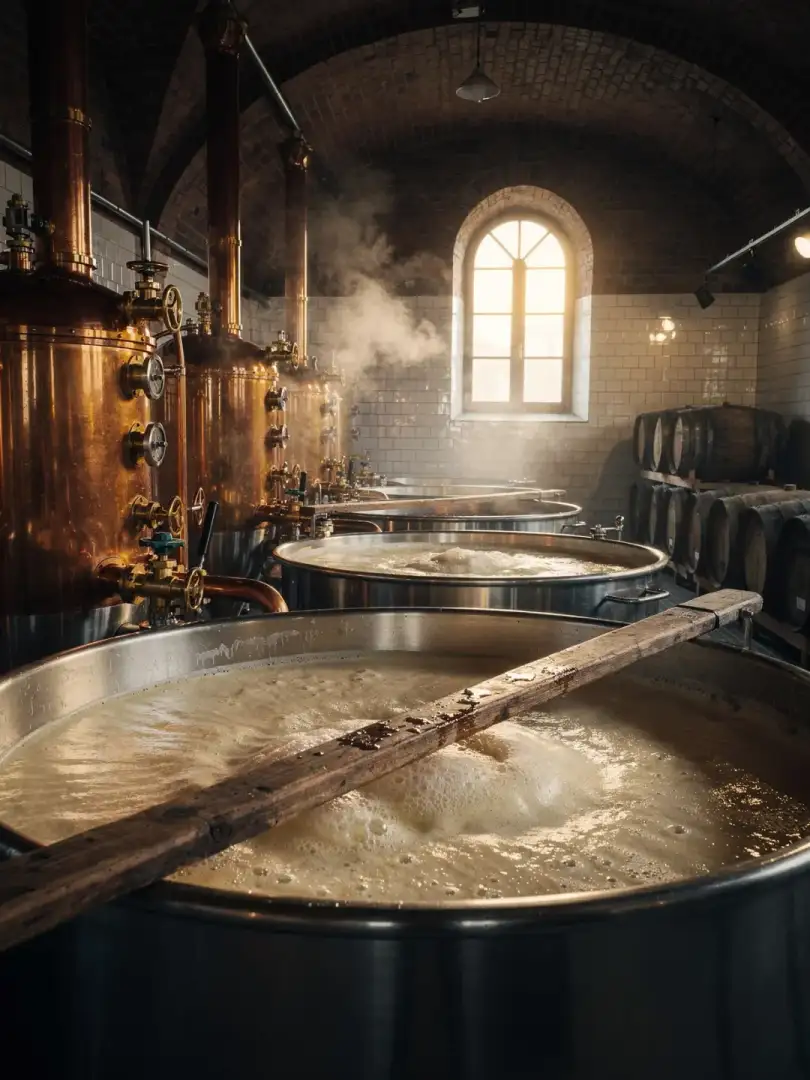
Yeast is absent from the 1516 wording, yet beer was still brewed with yeast. People simply didn't recognize it as a living organism. Brewers would add some of the sediment from the last batch to the new one, or pour fresh wort into a barrel that had already fermented something else, and fermentation would simply start up again.
Yeast wasn't understood as a microorganism until the 19th century, thanks to Louis Pasteur and Emil Christian Hansen. In 1883, Hansen isolated the first pure-culture bottom-fermenting yeast strain at the Carlsberg laboratory in Copenhagen. It was the very same yeast strain Carlsberg had obtained from Spaten in Munich back in 1845.
Yeast appears late in legal texts. Bamberg already named it in 1489. In Bavaria, it's only explicitly included since the 1910 amendment to the Malt Tax Law: malt, hops, yeast, and water. So anyone calling 'water, malt, hops, yeast' the Reinheitsgebot of 1516 is retroactively rewriting the original wording.
Today, yeast is one of the four ingredients listed in Section 9 of the Provisional Beer Law. Bottom-fermenting means the yeast works at cooler temperatures and sinks to the bottom at the end of fermentation—this is how Helles and Pilsner are made. Top-fermenting means it rises and works at warmer temperatures, producing Weissbier, as seen in Herrnbräu's Hefeweißbier.
Both yeast types are part of everyday brewing in Ingolstadt. Herrnbräu, by its own description, makes Weissbiers as well as bottom-fermented styles, while Nordbräu's lineup includes Pilsner, Helles, Weissbier, and Kellerbier. How long any individual batch ferments is something only the breweries themselves can tell you.