Cold Winters, Ice
Water & Soil
What water is Kulmbacher Bier brewed with? There's no reliable hardness figure covering every brewhouse in the region, and no verified measurement is available for this text, so none is given here. What's certain is that nearly all breweries today treat their water, softening it or adjusting it with salts. So water barely shapes the style anymore the way it once did.
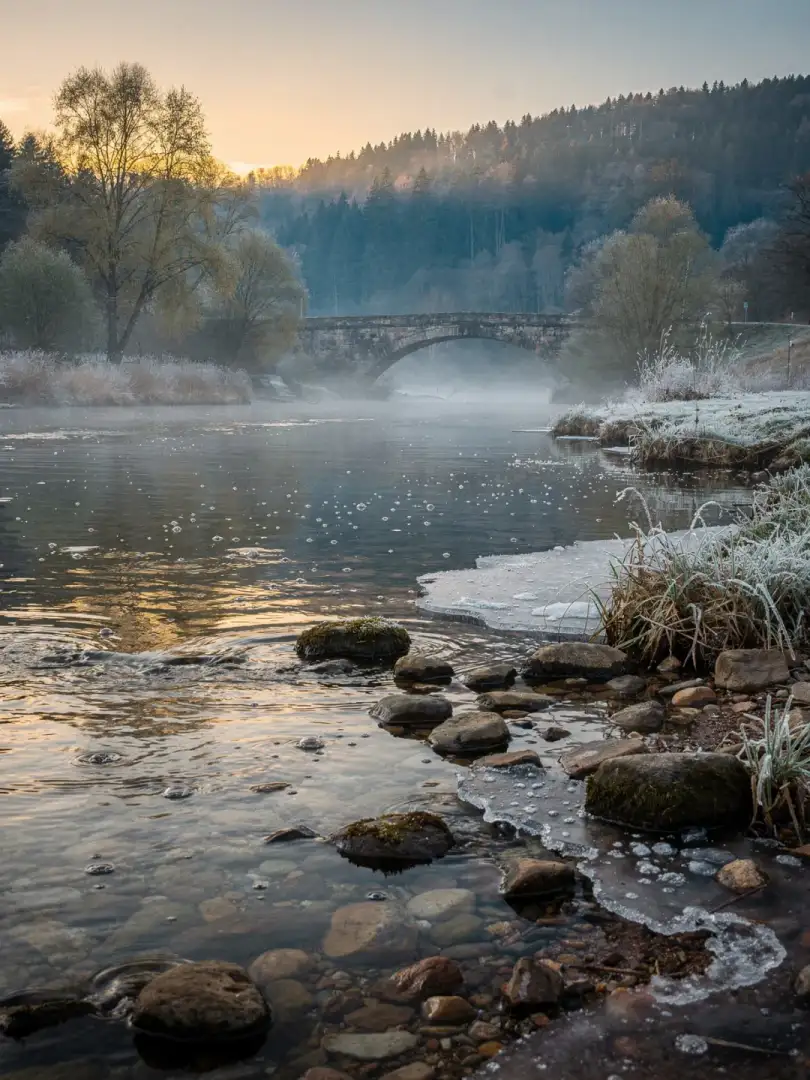
The landscape still explains a few things. Near Kulmbach, the Weisser Main and Roter Main rivers join to form the Main, and Bayreuth sits on the Roter Main. Both towns face harsh winters, bordered to the north by the Fichtelgebirge and Frankenwald. Anyone wanting to store beer here in the 19th century needed cold — and winter provided it for free.
This also explains the Kulmbacher Eisbock. Water freezes at zero degrees Celsius, while beer with several percent alcohol only freezes two to three degrees below that. Cool a strong Bockbier down far enough, and the water in the beer freezes first, into ice. Remove the ice, and what's left is a smaller but stronger, more concentrated beer.
The breweries sit on slopes and in valleys, not on one uniform rock formation like in Bamberg. Lagering cellars are still part of Kulmbach's brewing history, since before refrigeration, keeping things cool was every brewer's main challenge. Exactly where each cellar lies is something the individual houses state themselves.
Whether a brewery's water is soft or hard reveals less about the beer than the recipe in the brewhouse. Anyone wanting to get to know the region is better off tasting the result in the glass than asking about hardness levels.