Barely Any Bitterness
Hops
How bitter is Gose? Barely at all. By style standard, bitterness falls between 5 and 12 IBU, a scale for bittering compounds. For comparison, a German Pils ranges from 22 to 40. Hops are deliberately held back in Gose so that acidity, salt, and coriander can take center stage.
Hopping still happens, if only for shelf stability. In Leipziger Gose it remains a footnote, whereas in a Pils like Ur-Krostitzer, hops take the lead. Hop resins act against certain microbes and help support the foam. In a beer that already carries lactic acid, a small amount suffices, and brewers choose gentle varieties without strong fruity aromas so as not to clash with the coriander spice.
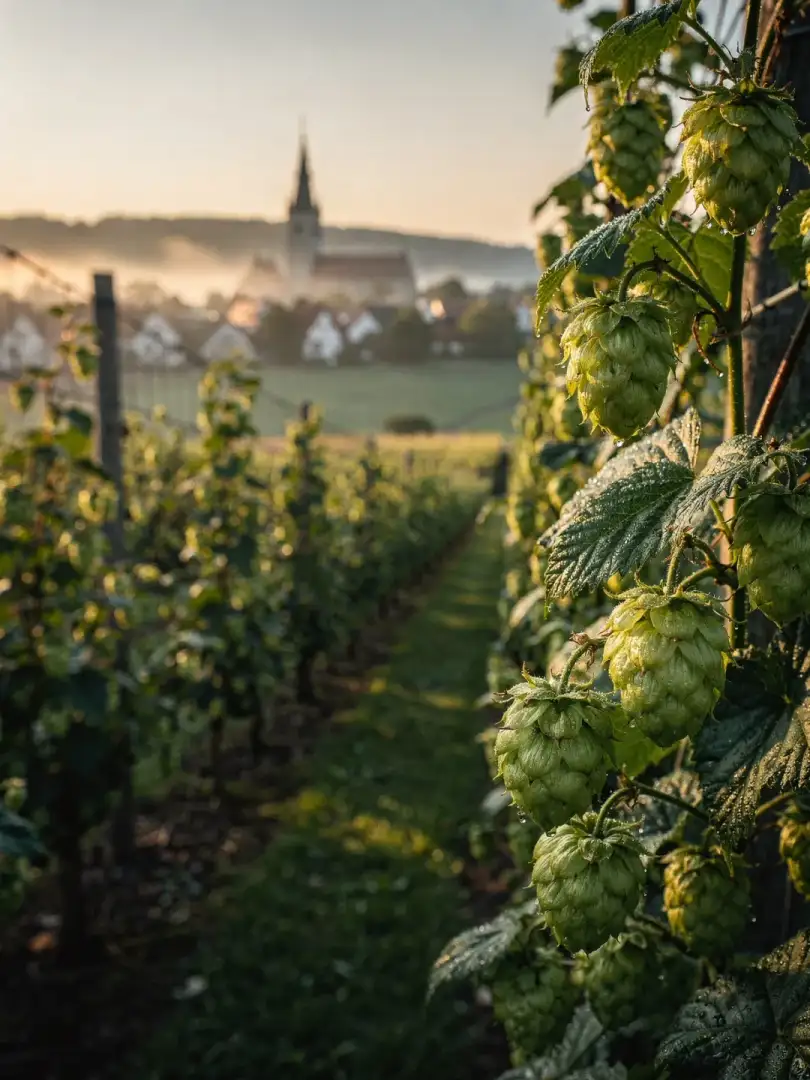
Locally, the hops come from the Elbe-Saale growing region, which spans Saxony, Saxony-Anhalt, and Thuringia. It has held EU-protected designation of origin status since 2014 and covers around 1,550 hectares according to available figures. The region grows mainly bittering varieties such as Magnum and Herkules.
Bittering hops are varieties high in alpha acid, the compound responsible for bitterness. They need only small quantities to take effect. That's enough for Gose, though breweries don't consistently disclose whether any given Leipzig batch actually uses Elbe-Saale hops.
No hops grow in Leipzig itself in any meaningful quantity. The city is a place of consumption and brewing, not cultivation. Anyone wanting to see hop gardens has to travel to the surrounding countryside—and anyone wanting to understand Gose needs to focus not on its hops, but on its acidity.