Bitterness from Elsewhere
Hops
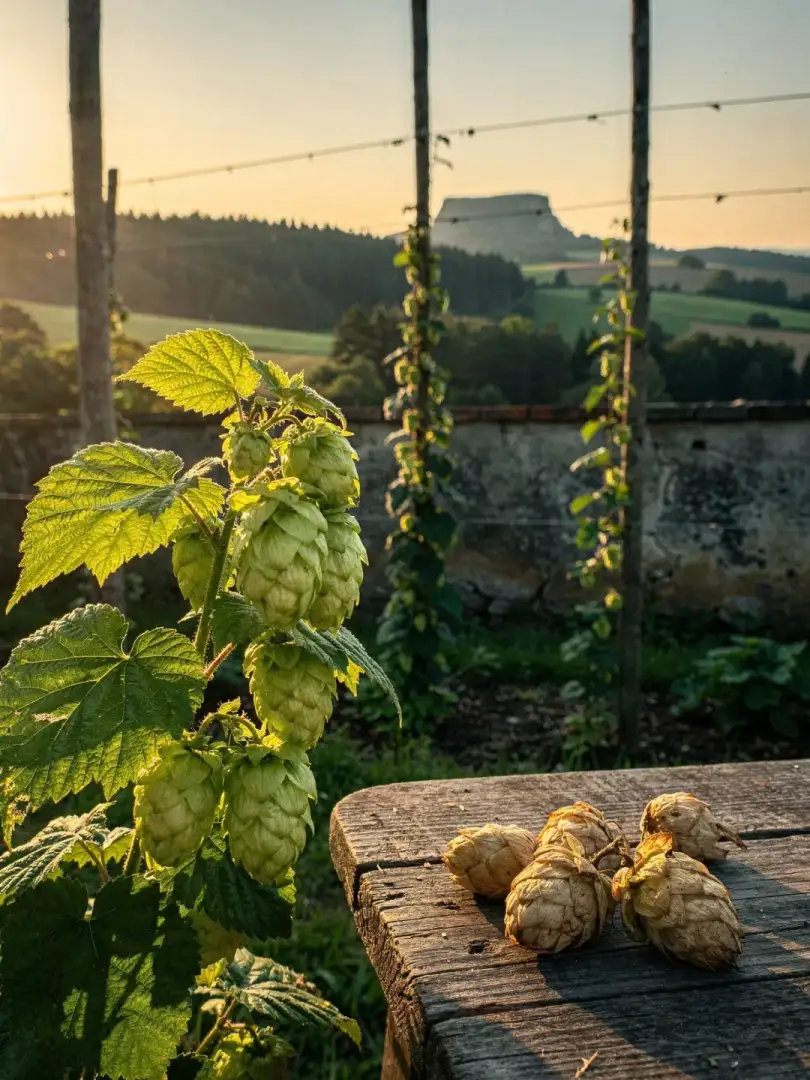
Hops aren’t grown to any significant extent in the Rhön. The high altitude, cool winds and short summers don’t suit the tall trellis systems familiar from the Hallertau. Rhön brewers therefore buy in their hops, usually from Germany’s major hop-growing regions. That holds true for Rother Bräu as much as for the monastery brewery on the Kreuzberg.
A look at the numbers shows why that makes sense. In 2025, according to the BarthHaas report, around 18,962 hectares of hops were under cultivation in Germany, the vast majority of it in the Hallertau in Bavaria. Much of what ends up in beer kettles across Germany comes from there. For small operations like Pax Bräu in Oberelsbach, growing their own hops simply isn’t worthwhile — buying in is easier and delivers consistent quality.
Few Rhön breweries disclose exactly which hop varieties they use. What can reliably be described, though, is what hops do in beer: they add bitterness and help preserve it, and they bring aroma — herbal, floral or citrusy.
Bittering hops and aroma hops serve different purposes. Bittering hops boil for a long time in the wort, the sugar solution before fermentation, and mainly deliver bitterness. Aroma hops go into the kettle late, so their fragrance doesn’t boil away.
In the region’s Pils, hops show through most clearly, with a dry, slightly bitter finish. In the monastery Dunkel, by contrast, hops step back behind the malt, their bitterness supporting the sweetness rather than overpowering it. The Kreuzberger Klosterbier is a good example of this — it tastes of malt first, and only then of hops.