Bitterness from Bavaria
Hops
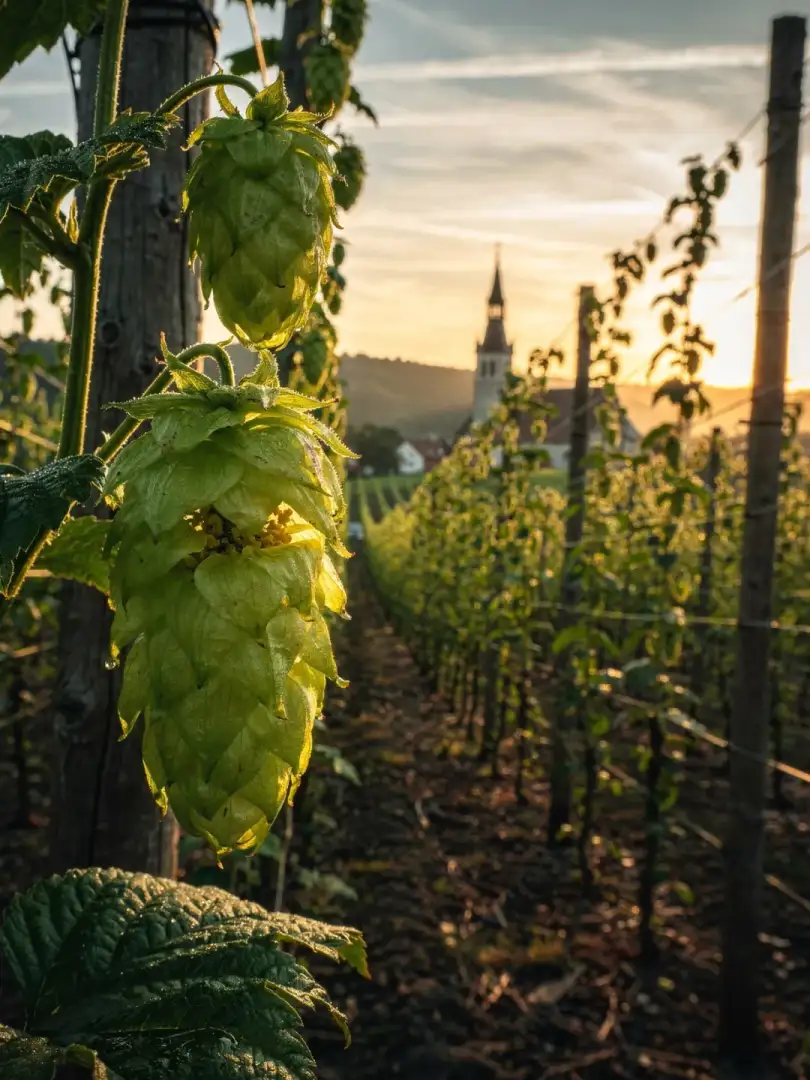
No hops grow in Sauerland or Siegerland, at least not in any notable quantity that this research could find. Hops grow on trellis systems and thrive on wide, open fields — something this low mountain range rarely offers. The Pilsner brewers therefore buy their hops on the open market or under contract, just like nearly all breweries outside the designated growing regions. That means the hops used by these Pilsner brewers come from elsewhere — in Germany, primarily from the Hallertau region in Bavaria.
The Hallertau, at roughly 17,100 hectares, accounts for about 83 percent of Germany's total hop-growing area and is the largest contiguous hop region in the world. Germany as a whole reached around 18,960 hectares in 2025, according to the BarthHaas report.
Brewers distinguish between two roles for hops. Bittering hops contain high levels of alpha acids and give the beer its bitterness, measured in IBU, the scale used for bitterness units in beer. Aroma hops are added later in the boil and contribute fragrance rather than sharpness.
According to BJCP style guidelines, a German Pils sits at 22 to 40 IBU, making it notably more bitter than a Helles, which ranges only from 16 to 22. Typical German varieties include Hallertauer Mittelfrüh, Perle, and Tradition, along with the bittering hops Magnum and Herkules, which often appear in the bittering charge.
Which varieties Warsteiner, Veltins, and Krombacher use, and in what quantities, the breweries don't reveal in detail. From the style itself, only one thing can be inferred — and this holds true for the Pilsner from Warstein, Grevenstein, or Krombach alike: the Pilsner from this region is dry and bitter, but never harsh, since the soft water keeps the hop bitterness rounded.