Abbey, Princes, State
Region & History
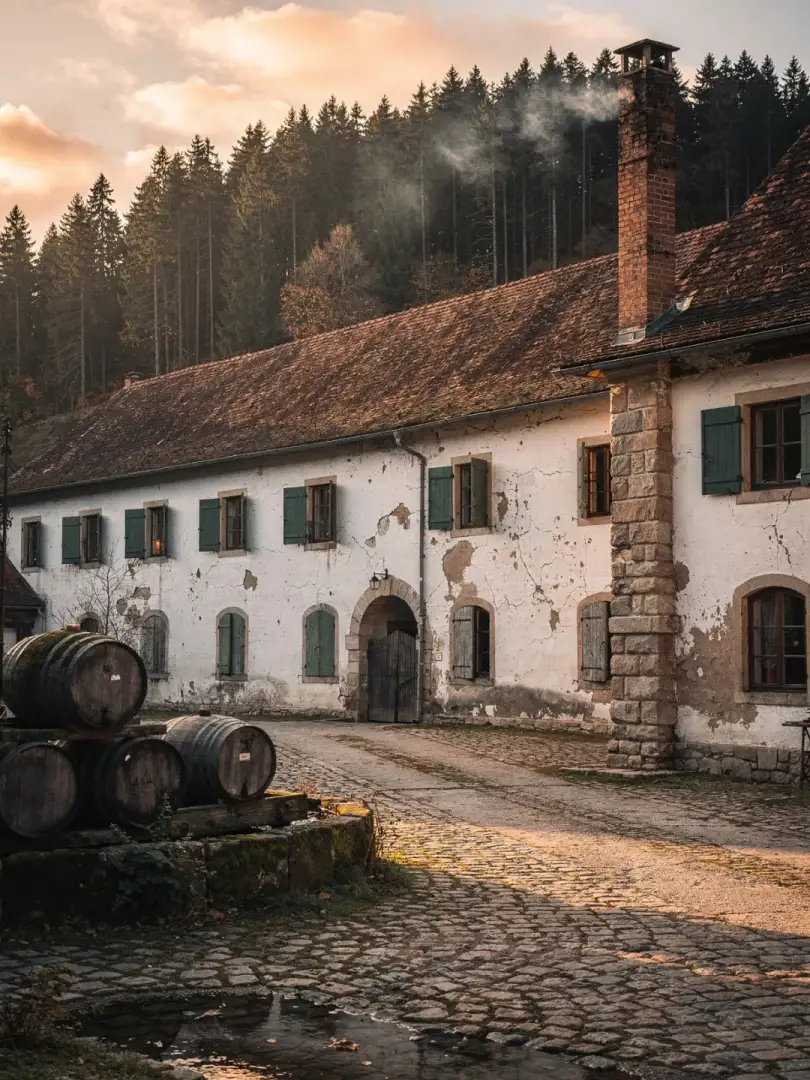
Why are there so many breweries in Black Forest towns that barely show up on a map? Because water and timber were abundant. When the Abbey of St. Blasien acquired the Rothaus site in 1766, it built a brewery there in 1791, according to the brewery's own records. Deep in the high forest, they found springs and firewood for the brew kettle—hardly a better location could be found.
After the dissolution of the monasteries, Rothaus passed to the state of Baden in 1806. Today the house is called Badische Staatsbrauerei Rothaus AG and belongs to the German state of Baden-Württemberg, making it one of the few state-owned breweries in Germany.
One brewery in the valley is even older. The Fürstenberg family in Donaueschingen trace their history back to 1283, when King Rudolf I granted Count Heinrich I of Fürstenberg the rights of a Landgrave, and with them the right to brew. The building constructed in 1739 still stands on the same spot today, just a stone's throw from the castle and the source of the Danube.
In Alpirsbach, history took a pause. The monastery, founded in the 11th century, once had its own brewery, which later fell silent. Johann Gottfried Glauner bought it in 1877 and began brewing again. Since 1906 the operation has been known as Alpirsbacher Klosterbräu. The Waldhaus brewery in Weilheim joined the scene in 1833, with the Schmid family taking over in 1894.
There's no protected designation of origin for beer from the Black Forest. In the EU register, only the ham from this region is listed—not the beer. So when you read "Schwarzwald" on a label, it's a nod to the region, not a protected name. Founding years, by the way, are often figures provided by the breweries themselves, marking the first known document rather than necessarily continuous operation.