Bunter Sandstone and Granite
Water & Soil
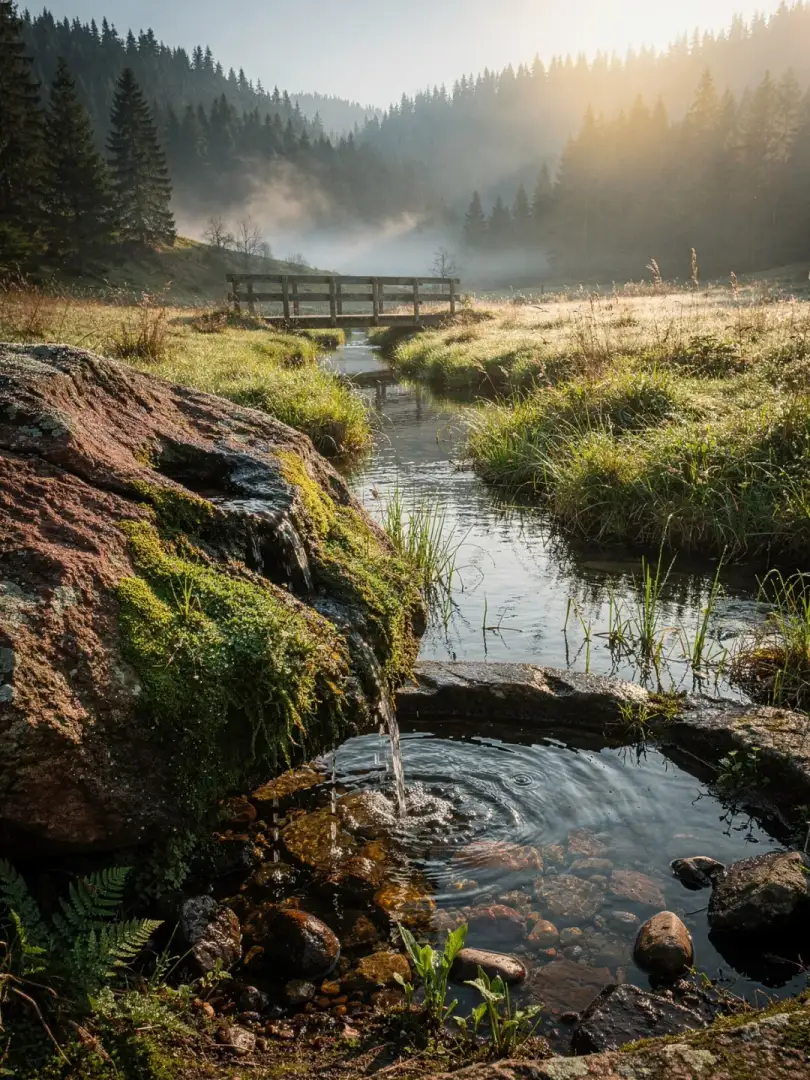
In Alpirsbach, the beer begins at a meadow. The brewery states that it draws its water from springs in the Glaswaldwiesen nature reserve, which rise through bunter sandstone. The sandstone filters the water and releases almost no lime. The brewery cites a hardness of around two degrees German hardness—extremely soft.
Just how soft is that? Hardness measures how much lime and magnesium the water contains. A value around two is far below what comes out of many taps. For comparison, the brewing water in Pilsen is also known for being exceptionally low in minerals—which is exactly what allows a pale beer with crisp, clean bitterness to shine there.
The Waldhaus brewery near Weilheim, sitting at about 800 meters above sea level, draws its water from five of its own springs, according to the brewery. Rothaus lies near Grafenhausen at roughly 1,000 meters, close to the Schluchsee, and promotes its beer as made with pure Black Forest spring water. Exact hardness values for these wells aren't documented, so no figure is given here.
Fürstenberg takes a different route, using soft water from its own deep well right in the middle of Donaueschingen. The source changes, but the effect is similar. Soft water lets hops and malt shine through clearly, without the harshness that very mineral-rich water can bring.
It's not quite as simple these days as saying water alone defines the style. Many breweries treat their water. But where naturally soft water already flows, little treatment is needed—and that's exactly the advantage of the High Black Forest. The cool mountain air adds to the picture too, as we'll see with fermentation.