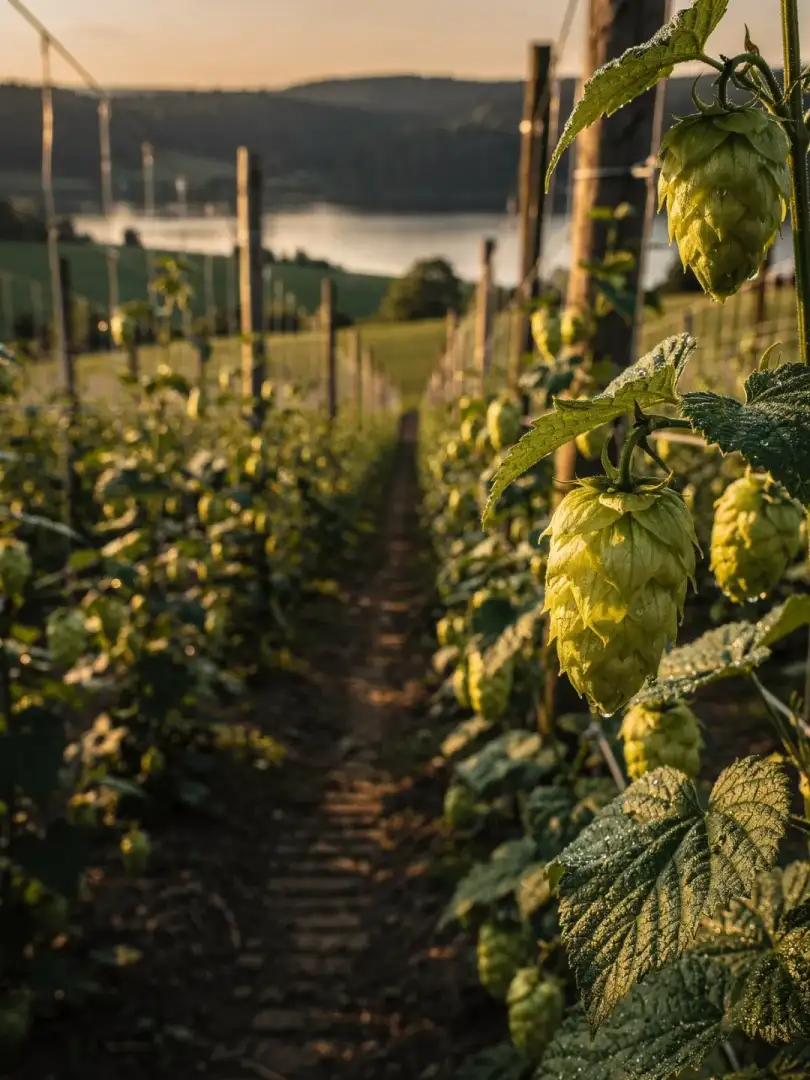
Tettnang and Hallertau
Hops
No significant amount of hops grows in the Black Forest itself. Brewers source them from elsewhere, mainly from two regions. Rothaus names aroma hops from Tettnang and the Hallertau for its Pils, and Fürstenberg likewise relies on aroma and bittering hops from these two areas.
Tettnang lies on Lake Constance, not far away. Tettnang hops carry an EU-protected designation of origin and are prized for their fine, spicy character. The Hallertau in Bavaria is the largest contiguous hop-growing region in the world, covering roughly 17,129 hectares—around 83 percent of Germany's total hop acreage.
Why use two kinds of hops? Bittering hops are rich in alpha acids, the compounds that transfer into the wort during boiling and create bitterness. Aroma hops, by contrast, provide oils that carry notes of herbs, blossoms, or fresh grass. A Pils needs both. The bitterness gives it backbone, while the aroma decides whether the beer feels smooth or sharp—and both come from the same plant, just different varieties.
How bitter a Black Forest Pils turns out is measured in IBU, or International Bitterness Units. For a German-style Pils, the BJCP competition guidelines set the range at 22 to 40 IBU. Individual breweries may fall below or above that range—you won't find the number on any label.
Waldhaus emphasizes that it uses whole-cone natural hops rather than extracts, a practice the brewery says few German breweries still follow. Legally, hop powder and extracts are permitted. So it's a voluntary choice by the brewery—one you can barely taste in the glass, but can sometimes sense in the aroma of a freshly poured Pils, when the hop character comes through clean and bright.