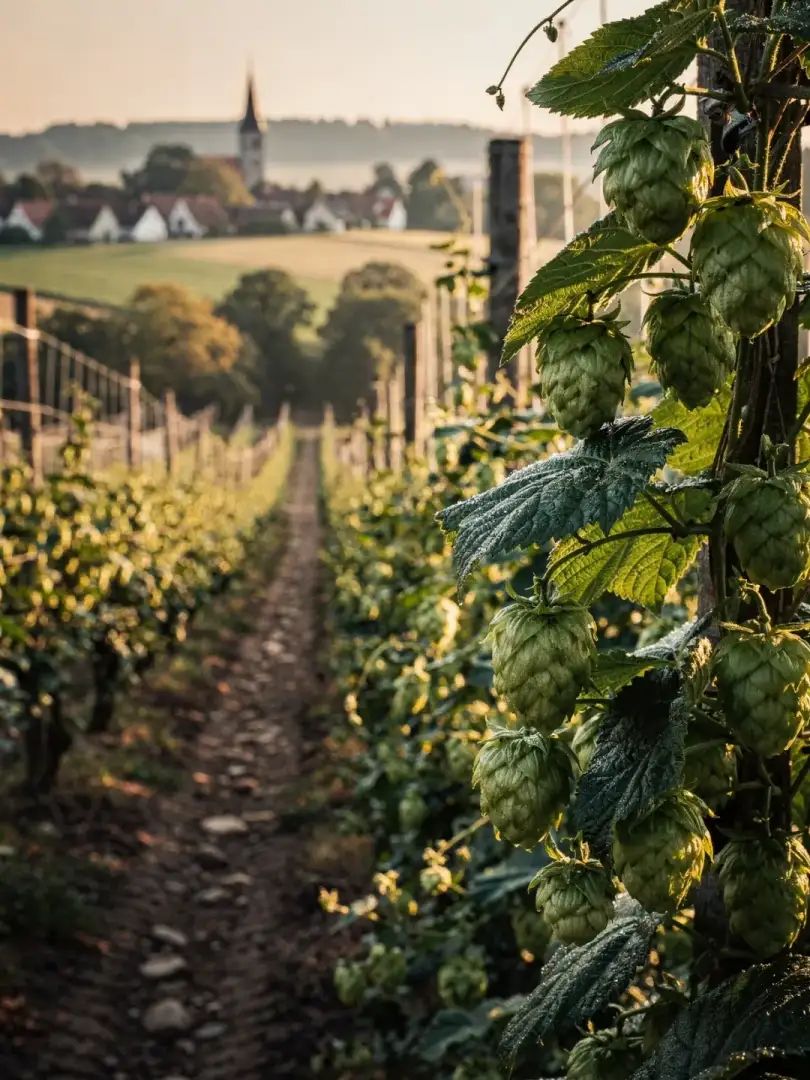
Spalter Aroma Hop
Hops
Spalt is one of Germany's smaller hop-growing regions. According to the region, family-run farms cultivate about 350 hectares. All of Germany grew hops on 18,962 hectares in 2025, so Spalt accounts for just a fraction of that. But the name stands for finesse rather than volume, and brewers around the world seek out exactly this mild, refined character when brewing a classic lager.
The Spalter is an old landrace from the Saaz family, named after the Czech town of Žatec, where noble aroma hops have grown for a long time. Its alpha acid — the compound responsible for bitterness — sits at 2.5 to 5.5 percent. That's low. Its job isn't primarily to add bitterness but to bring fragrance: floral, fruity, spicy.
Then there's Spalter Select, a cultivar bred at the Hüll Hop Research Center and registered as a variety in 1993. It's hardier and higher-yielding, with a spicy-floral aroma carrying herbal notes, and at 3 to 6.5 percent alpha acid still mild. It's considered a classic hop for lagers and Pilsner.
Harvest falls between late August and mid-September. The cones are picked, dried, pressed, and either chilled or processed into pellets. The Hersbrucker Alb, a bit further north, has its own variety in Hersbrucker Spät, but no EU designation of origin. Spalt Spalter, by contrast, carries PDO protection.
Bitterness and aroma emerge at different stages. Add hops early in the boil and you extract bitterness; add them late and you preserve the volatile aroma oils. Aroma hops like the Spalter tend to go in late, so their fragrance doesn't evaporate in the kettle but arrives intact in the finished beer, where you can smell it later.