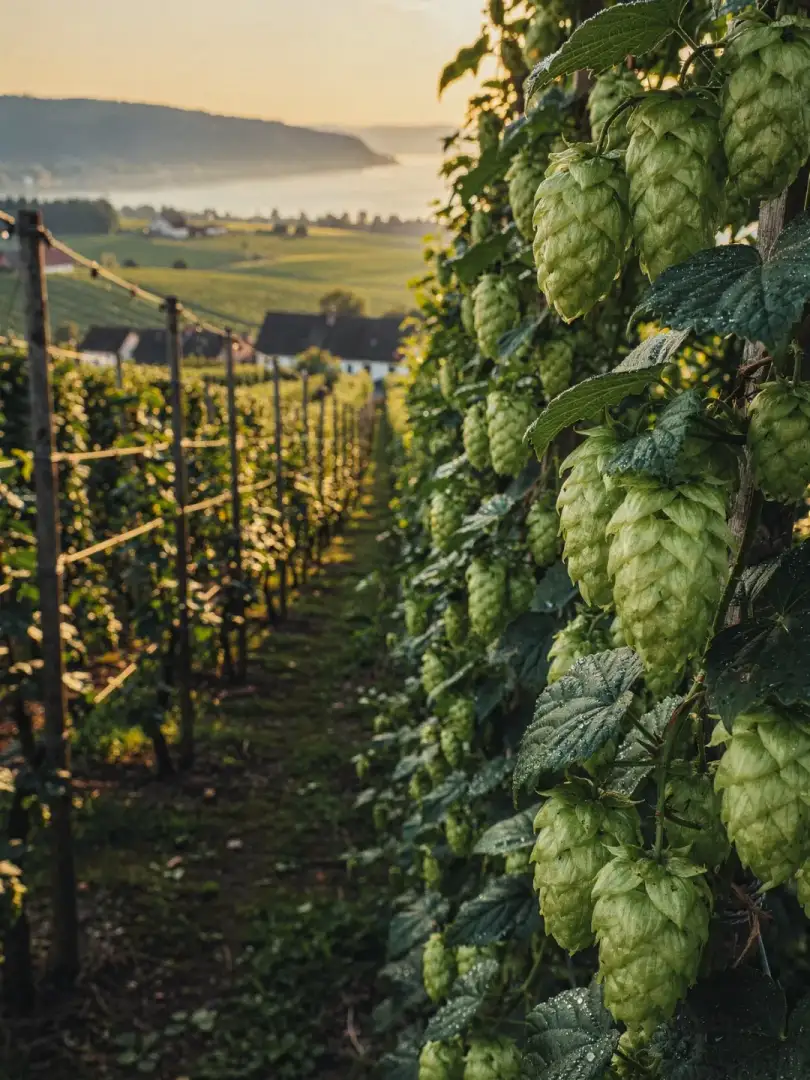
Aroma, Not Force
Hops
Tettnang is home to hops that smell of blossom and spice rather than raw power. The signature variety is simply called Tettnanger. It covers about 60 percent of the growing area, more than 600 hectares, and is prized as a delicate aroma hop.
What exactly is an aroma hop? Hops give beer two things: bitterness, which comes from the alpha acids in the cones, and aroma, carried by essential oils. Aroma hops are valued for their fragrance and are often added late in the boil so that aroma is preserved. Bittering hops, by contrast, are boiled mainly to extract bitterness.
Both are found at the lake. The high-alpha variety Herkules grows on about 300 hectares and, according to the region, is the most widely cultivated hop variety in the world. In total, more than 20 varieties are grown here. Since the 1990s, new breeds from Hüll have been added, and since 2012 the Flavor Hops, which aim at the craft beer scene with notes of melon or tangerine.
The harvest begins around August 25th and runs through September. The vines, which can grow to over eight meters tall, are cut down and the cones are picked by machine—once this was done by hand. On average, only about 100 grams of dried hops are needed for 100 liters of beer.
Producers also use Tettnang hops outside the region. Fürstenberg, for instance, cites a blend of Hallertau and Tettnang aroma hops for its Premium Pilsener. According to the brewery, Ruppaner Bodensee Pils relies on five dry-hopped varieties, including Tettnang Tettnanger. Dry hopping means the hops are added to the beer only after boiling, contributing aroma but hardly any bitterness.