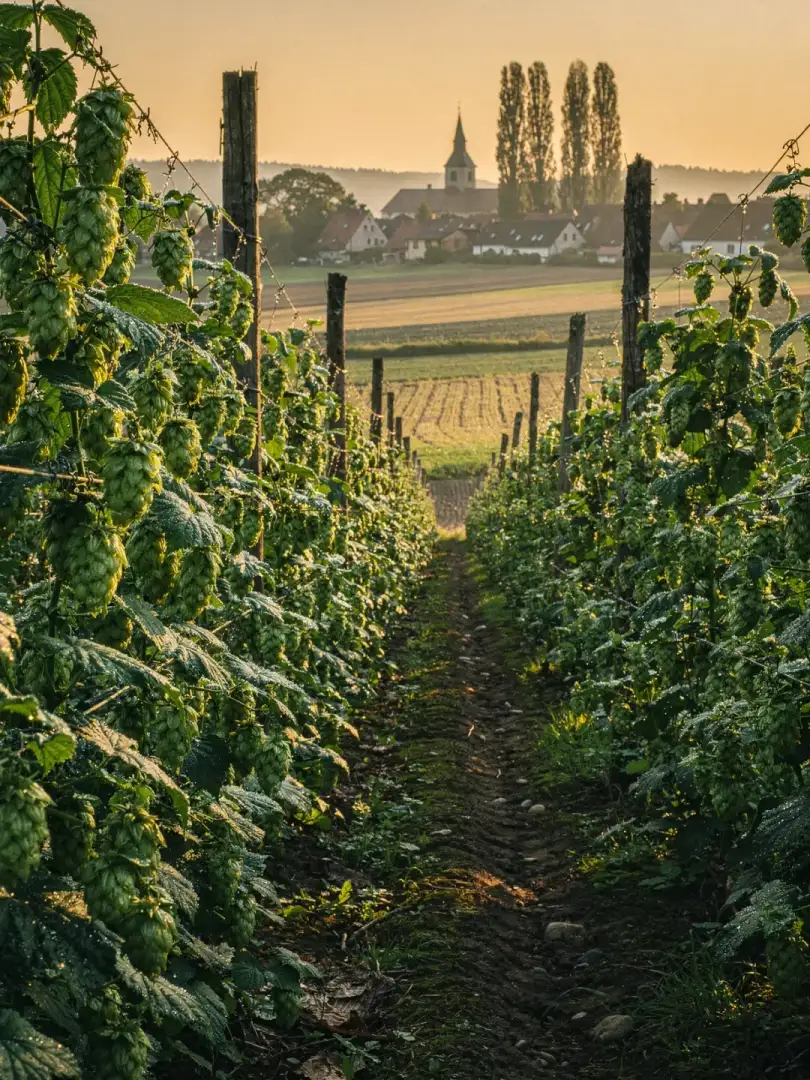
Germany's Northernmost Hop Country
Hops
Hops do grow in Thuringia, though not in the quantities seen in Bavaria. The region belongs to the Elbe-Saale growing area, Germany's northernmost hop-growing region, which stretches across Thuringia, Saxony and Saxony-Anhalt. According to the Hop Growers' Association, it is the country's second-largest hop region after the Hallertau.
Depending on the source, Thuringia accounts for roughly 350 to 410 hectares. Current market reports put the entire Elbe-Saale region at about 1,550 hectares, around eight percent of Germany's hop acreage. Since 2014, the name Elbe-Saale Hopfen has been registered as a Protected Geographical Indication in the EU.
The leading variety is Magnum, a high-alpha hop bred in Hüll and approved in 1993. Alongside it stands Herkules, also a bittering hop, and aroma varieties like Perle. Perle and Northern Brewer are considered further standard varieties in the region.
Bittering hops and aroma hops differ in how they're used. The bittering compounds are released during the long boil of the wort, the sweetened liquid made from malt and water. Aroma compounds evaporate under heat and survive only if the hops are added toward the end of the boil or later.
Schwarzbier doesn't call for a hop bomb. The style guideline sits at 20 to 35 bitterness units, a measure of bitterness. Hops are meant to keep the beer in balance, preventing roasted malt and sweetness from merging into one, and to stay in the background. That's why Köstritzer Schwarzbier and its relatives call for a rather restrained hop addition, while a pale Pilsner is hopped noticeably more assertively.