Granite and cellar
Water & Soil
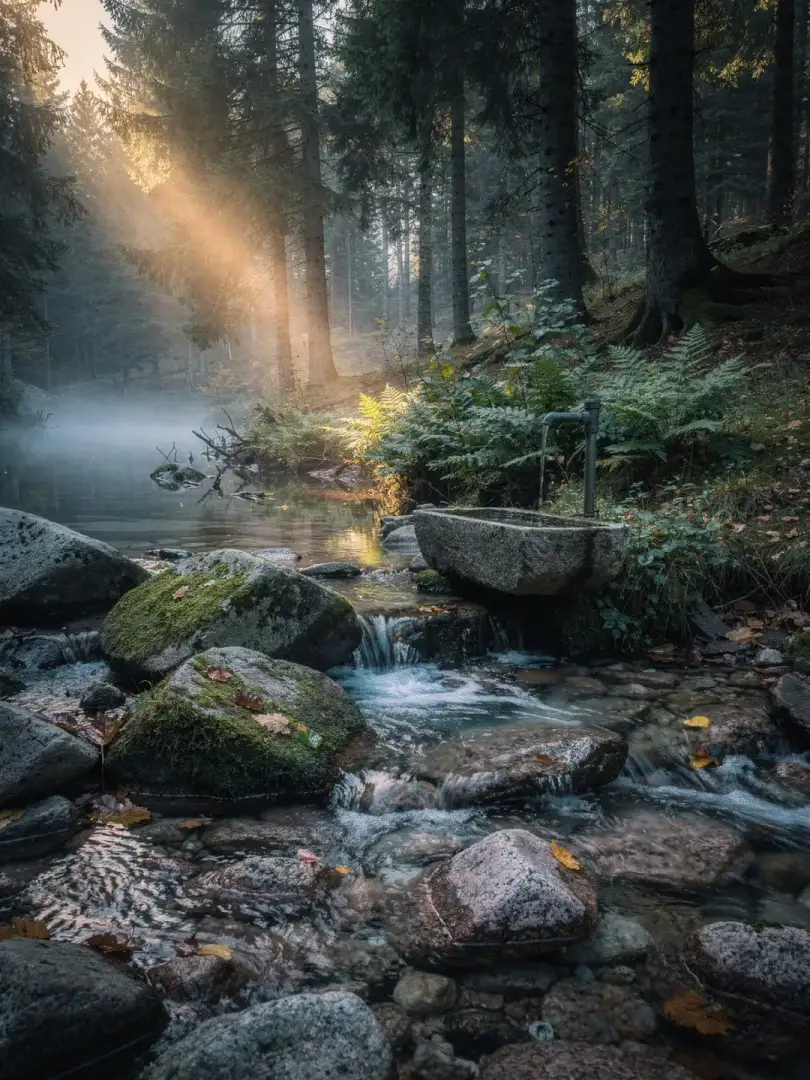
Between the Oberpfälzer Wald, the Stiftland, and the Bohemian border, the ground is hard, ancient rock. Granite and gneiss shape the area around Windischeschenbach and Mitterteich, and this kind of rock typically yields rather soft water, meaning water with few dissolved lime and mineral salts.
For a malt-forward beer, that's a good starting point. Soft water lets the hop bitterness come across more gently, and the beer's body feels rounder than it would with heavily mineralized water. We won't cite exact hardness values for individual brewhouses here, since these vary by source and by year.
The climate is rugged. The Oberpfälzer Wald has cool summers and long, cold winters, and Zoigl brewing is built precisely around that. The wort cools overnight in an open, shallow basin in the brewhouse called the cooling ship, with the night air doing much of the work.
Storage doesn't happen in the brewhouse but in the cellars of the Rechtler. How much rock surrounds the barrels there is up to each household. What matters is that the cellar stays cool even in summer, since bottom-fermenting yeast works best at low temperatures.
Water only makes a difference in beer when it suits the recipe. Many brewers today adjust their water, whether with salts or by softening it. Whether a communal brewhouse does this isn't widely documented. So the claim about soft water remains a rule of thumb for the region, not a guarantee for every batch.