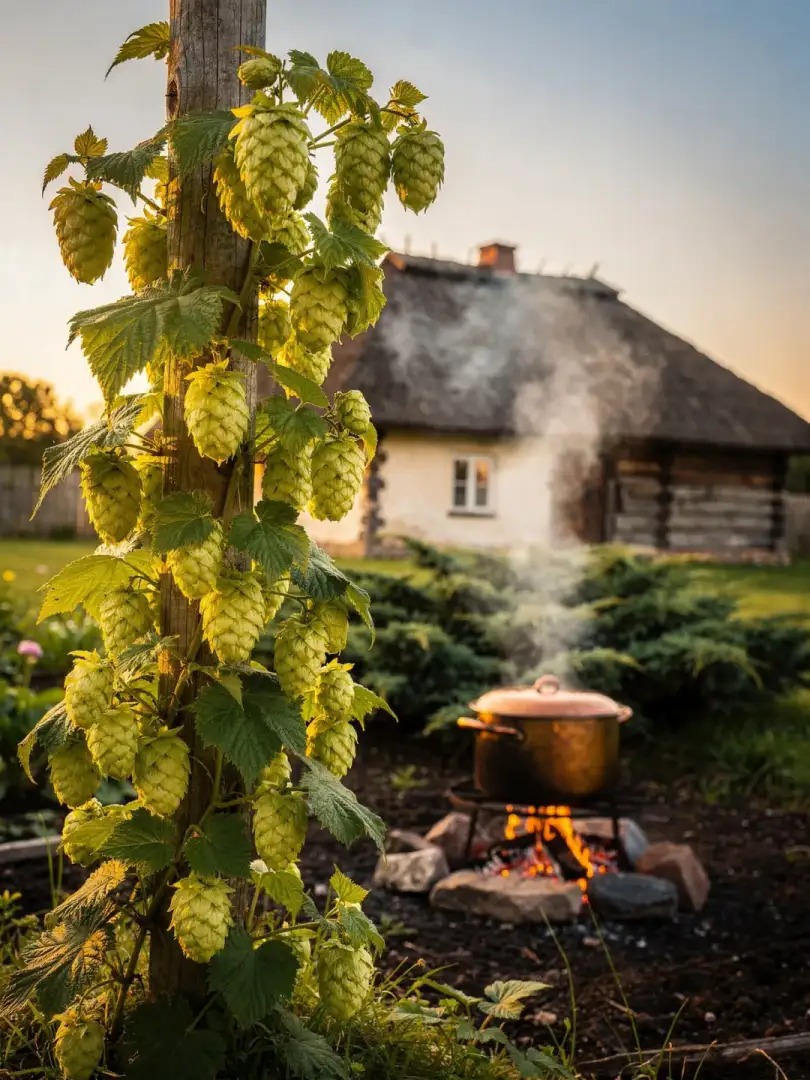
Humalavesi, hop tea
Hops
In classic Koduõlu, hops play almost no role. Garshol could only find records of quantities from three brewers: 0.54, 0.83, and 2.7 grams per litre. By comparison, a well-hopped pilsner needs many times that amount to achieve a clean bitterness. He estimates the bitterness at roughly 5 to 10 IBU, a scale for bitter compounds in beer.
Hops weren't added to the wort itself but boiled separately in water. This hop tea is called humalavesi in Estonian, literally "hop water." Depending on the farm, it was added at different points—sometimes to the mash, sometimes later in the brew.
The reason lies in the process. If you don't boil the wort, you can't extract hop bitterness from it directly, since bitter compounds only dissolve properly under heat. Hop tea was the workaround: it brought some bitterness into the beer while only needing to simmer in its own separate pot.
So juniper set the tone in the glass. The beer smells of resinous needles and spice, with malt coming through only afterward. Some brewers also added bog myrtle, a marsh plant with a resinous, spicy aroma.
With Estonia's new craft beer scene, hops are playing a bigger role again. The Baltic Porter style calls for 20 to 40 IBU, and in Põhjala's Öö the roasted character keeps the hops in check. Here bitterness acts as a counterweight to sweetness and roast, not the main event, and a careful taster will only notice it in the finish.