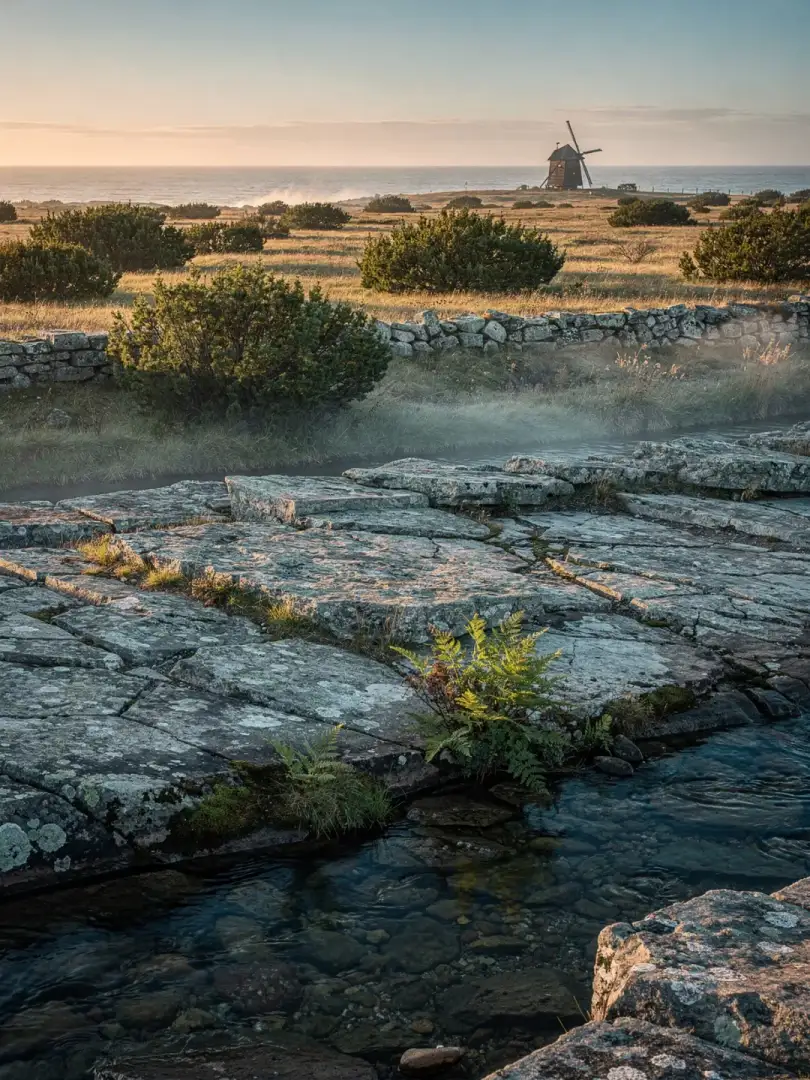
Limestone, juniper heath
Water & Soil
Saaremaa sits on limestone and dolomite that formed on the seabed during the Silurian period. Travelling across the island, you see flat land, stone walls, windmills, and meadows where juniper grows. There are no large rivers; farms drew their water from wells.
Limestone bedrock usually makes groundwater hard, meaning rich in dissolved minerals. For a pale beer, that often gives a somewhat austere edge. No one ever measured the water hardness of any individual farm for the sake of beer history, so any figure here remains speculative.
More important than mineral content for Koduõlu was another ingredient drawn from the island's soil. Juniper grows almost everywhere on the sparse pastures. Brewers boiled the branches in water and used this infusion instead of plain water for mashing. This way, the juniper flavour entered the beer before lautering even began, and the water itself took a back seat.
The Baltic climate also shapes how the beer is kept. Winters are long and cold, summers mild, and a beer that's neither boiled nor preserved with much hop bitterness doesn't keep for long. Koduõlu was therefore drunk young, just days after fermentation, straight from the cask or from a jug emptied the same day.
In Tallinn and Tartu, the water comes from the municipal supply. The newer breweries there rely less on the source and more on the recipe. Põhjala, for instance, promotes ingredients drawn from the country's forests—birch, according to the brewery, among others.