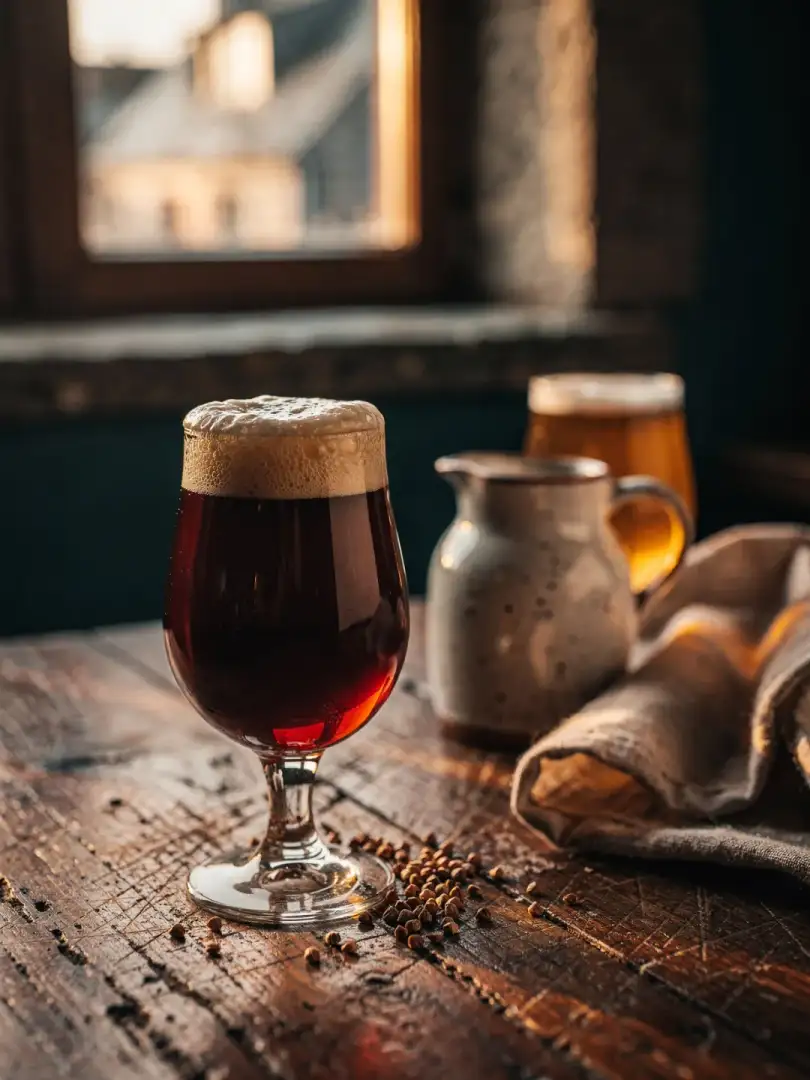
Blé noir, Ambrée
Beer Styles
What defines Breton beer? There's no protected 'Brittany style.' The major breweries' lineups consist of Blonde, Ambrée, Brune, Blanche, and Stout, plus the buckwheat beer as a regional specialty. Coreff's range includes Blanche, Blonde, Ambrée, Brune, and Stout.
The buckwheat beer, bière au blé noir in French, isn't a recognized style with set parameters—it's a recipe idea: buckwheat and barley malt in roughly equal parts, dark, moderately strong, with a bitter edge. Telenn Du from Brasserie Lancelot is the best-known example. There's no competition style guideline for it the way there is for Kölsch or Pils, so below are two styles that sit beside it on the shelf.
The Ambrée is an amber-colored ale. It sits between the pale Blonde and the dark Brune, and its roasted malt gives it a caramel note. A Brune is more deeply colored and tastes of more roasted malt, a Blonde is paler and simpler, and lining up all three glasses side by side, you can see the journey from straw-yellow to brown with your own eyes.
The Blanche belongs to the wheat beer family. The figures below for witbier are competition-style ranges for the style group, not values for individual breweries. The same goes for the stout, a name that originally just meant 'strong' and only later became famous as an Irish style.
These beers have little in common with the bière de garde from northern France. There, brewers make stronger, longer-keeping beers; here, ale styles and the buckwheat beer take center stage.
Witbiertop-fermented
- Original gravity
- 11–12.9 °P
- Alcohol
- 4.5–5.5 % vol
- Bitterness
- 8–20 IBU
- Colour
- 4–8 EBC
Hazy yellow, a delicate spice from coriander and orange peel, fresh and light.