Pale Malt
Malt & Grain
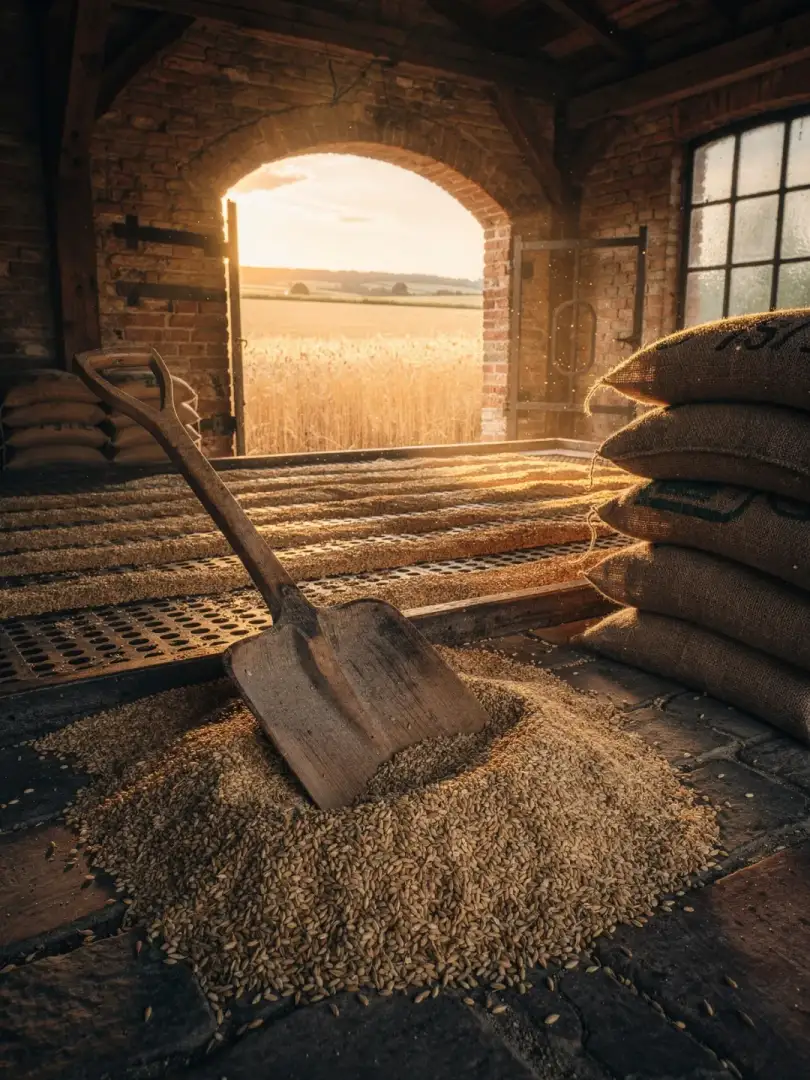
How does barley become malt? The grains are moistened until they sprout, then dried in a kiln called a kilning oven. In the process, starch converts into fermentable sugar. The hotter the kiln runs, the darker the malt becomes.
For a pale lager like Kronenbourg 1664, which the brewery markets as a pale lager at 5.5% ABV, pilsner malt is typically used, kilned gently. It delivers the golden color and a mild, bread-like sweetness, but no roasted notes. Color is measured in EBC units, with pale lagers falling in the range of roughly 4 to 12.
Does the Reinheitsgebot apply in Alsace? No. France has no regulation equivalent to the German purity law, so brewers are free to use ingredients such as corn or rice as part of the grain bill. Labels usually don't indicate which breweries do this. Anyone wanting to know what's actually in the beer is best off asking the brewery directly, and many small producers are happy to share that information.
Malt is only part of the equation. From 100 kilograms of grain, a brewery produces many times that volume in wort, and how much of it ferments determines the strength of the finished beer. That's why brewers consider the amount of dissolved sugar, the original gravity, one of their most important figures.
This poses no obstacle for the German market: since the 1987 European Court of Justice ruling, anything legally sold as beer in its country of origin may be sold as beer in Germany too. So a lager from Obernai can sit on the shelf right next to a Bavarian Helles, even though the two may be brewed quite differently.