Union Casks & Cask Ale
Yeast & Fermentation
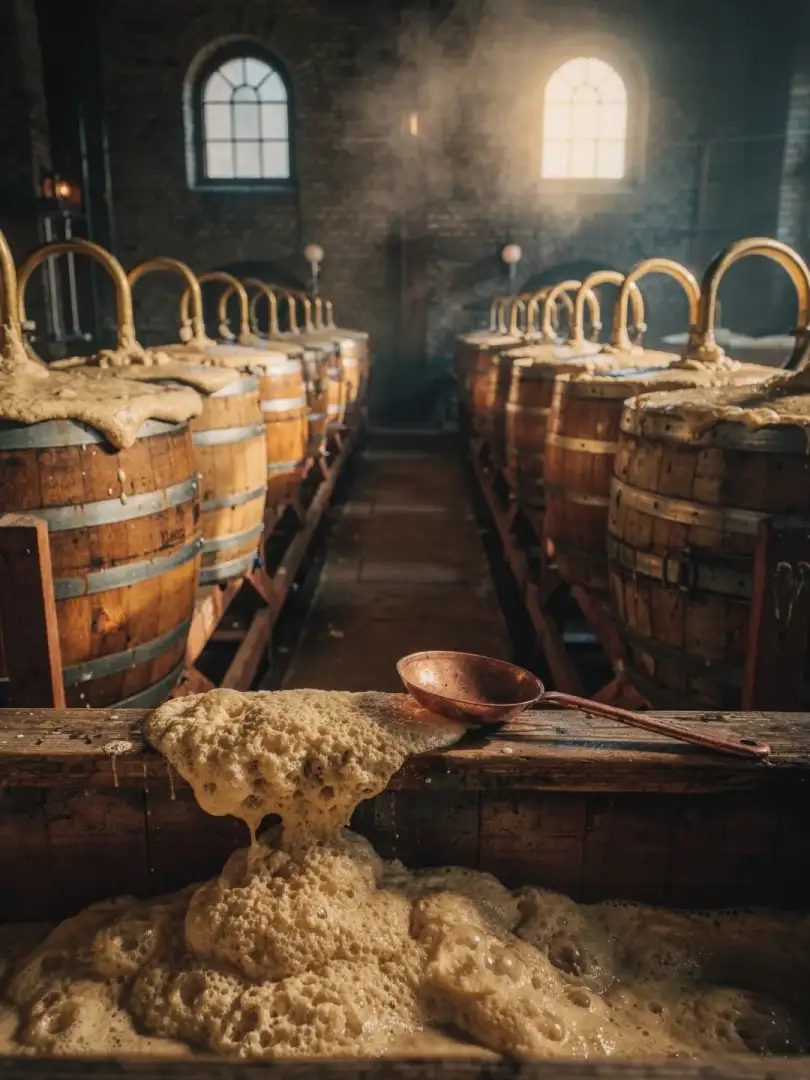
The Burton Union System was one of the rarest ways to ferment beer. Here, wort ferments not in an open vessel or tank, but in a row of connected oak casks. A set of these is called a Union Set. The casks sit above one another, and over each one a curved pipe, the swan neck, arches into a shared trough.
Here's how it works: yeast works inside the cask and produces foam. The foam pushes yeast and beer up through the swan neck into the trough. There the yeast settles, while the clear beer flows back down through a pipe into the casks. Skimming off the yeast leaves the beer nearly clarified before it's even packaged.
According to the brewery, Marston's Pedigree was the last beer still fermented in Union casks. In January 2024, the Carlsberg Marston's Brewing Company decided to decommission the last four sets, as cask beer volumes had declined. In July 2024, Carlsberg bought the remaining 40 percent of the Marston's brewery, and the Burton site has belonged to Carlsberg Britvic ever since.
Two sets remain standing in the brewery as a monument. Another system was rebuilt by Thornbridge Brewery in Bakewell using casks from Marston's, so the process wouldn't be lost entirely. Fermentation in wood is now part of the town's history rather than its daily operations.
Fermentation in Burton, as everywhere in England, is top-fermenting. The yeast rises to the surface during fermentation and forms a thick cap. Top-fermenting means it works at temperatures of around 18 to 22 degrees Celsius, warmer than lager yeast. After primary fermentation, cask ale continues to condition in the barrel, where residual sugar and yeast give it a gentle sparkle.