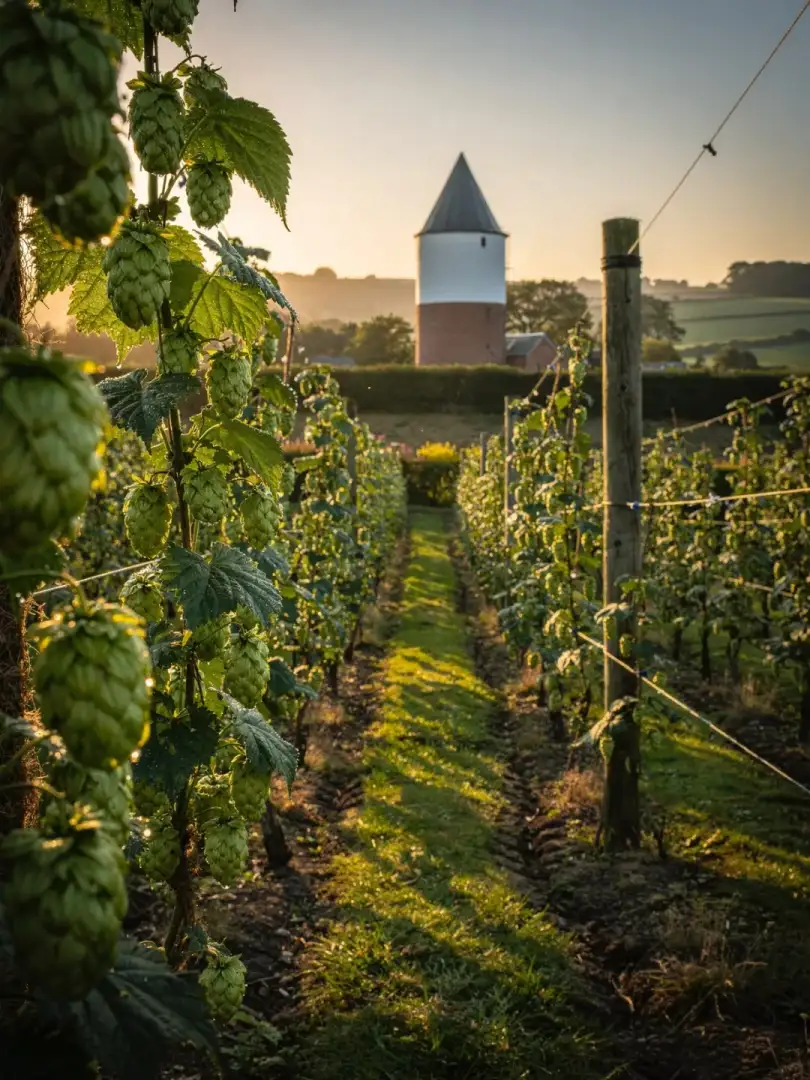
Kent, not Staffordshire
Hops
No hops grow in Burton upon Trent itself, yet you can taste them especially clearly in Bass and other Burton beers. Brewers sourced their hops from the hop gardens of southern England, above all from Kent and the counties bordering Wales. The railway that carried the casks away also brought in sacks of dried hop cones.
These cones are the flowers of the hop plant, giving beer its bitterness and aroma. The bitterness comes from resins that dissolve into the liquid as the wort — the sugary malt extract — boils. The aroma comes from oils that evaporate quickly during boiling and are therefore often added late.
Among the English classics are Fuggles and Goldings. East Kent Goldings has been registered as a Protected Designation of Origin (PDO) since 2013, meaning the variety must come from a specific part of Kent. Both varieties give beer earthy, floral, slightly spicy notes, rather than the fruitiness of American varieties.
In Burton, this spiciness meets the sulfate in the water. The water sharpens the bitterness without broadening it. This is how the dry, crisp bite that connoisseurs praise in a good Burton Pale Ale came about. If you want more aroma, you add hops late or dry-hop, but that's a more modern practice.
The ratio of bitterness to aroma determines the style. An English bitter typically sits at 25 to 40 International Bitterness Units (IBU), an English IPA at 40 to 60. The number indicates how much bittering substance is in each liter. It doesn't say how sharp the beer actually tastes, since malt sweetness balances a great deal.