Restrained Hopping
Hops
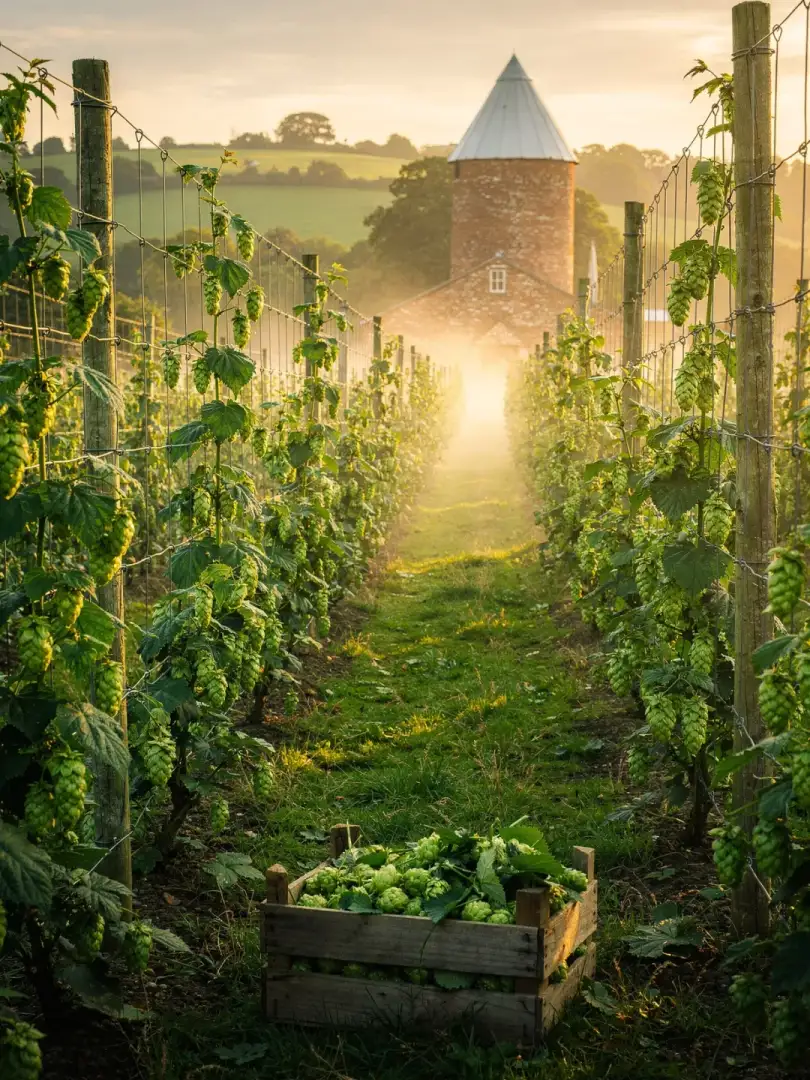
Hardly any hops grow in Scotland, and that was always true for Edinburgh. Brewers sourced their hops from the south of England, from Kent and the neighbouring counties. The classic English varieties Fuggle and East Kent Goldings grow there, and the name East Kent Goldings has carried EU PDO protection since 2013.
This suited the way Edinburgh beers were built. Hops provide two things: bitterness, which counters the sweetness of the malt, and aroma. Bitterness is measured in IBU, a scale of bitterness units. A light-style Scottish ale sits at just 10 to 20 IBU under BJCP standards, while a German Pilsner reaches 22 to 40. Here, the hop is meant to support the malt, not overpower it. Any Edinburgh brewer buying hops also paid for the long journey from the south, one more reason to use them sparingly.
Anyone looking for a hoppier Edinburgh beer can't avoid Deuchars IPA. The Caledonian Brewery introduced it in 1991, and it became the brewery's best-known beer and one of the city's favourites. IPA stands for India Pale Ale, a pale, heavily hopped export beer that found particular success in India. Deuchars IPA is noticeably more bitter and drier than an 80/-, though more moderate than a modern American IPA.
The beer is no longer brewed on Slateford Road. Since that brewery's closure, it has been produced at Belhaven in Dunbar.