The Shilling System
Beer Styles
What does 80/- on a Scottish beer mean? The number refers to shillings, a coin from before decimal currency. A shilling held twelve pence, and twenty shillings made a pound sterling, until Britain switched to decimal currency in 1971. The slash with a dash, "/-", simply means "shillings, no pence."
In the 19th century, brewers wrote invoices this way. The price applied to a hogshead, a cask of 54 imperial gallons, or just over 240 litres, and it rose with the strength of the beer. A 60/- was the everyday light beer, also called "Light"; a 70/- was known as "Heavy"; an 80/- as "Export." The more malt in the brew, the costlier it was, and the higher the price.
Roughly, these correspond to the following original gravities: a 60/- sits at about 7.5 to 8.75 degrees Plato, a 70/- at about 8.75 to 10, and an 80/- at about 10 to 13.75. Original gravity is the sugar content of the wort before fermentation. Today these are guidelines, not rules, and the number says nothing about the price in the glass. The Caledonian Brewery later renamed its 80/- "Edinburgh Castle."
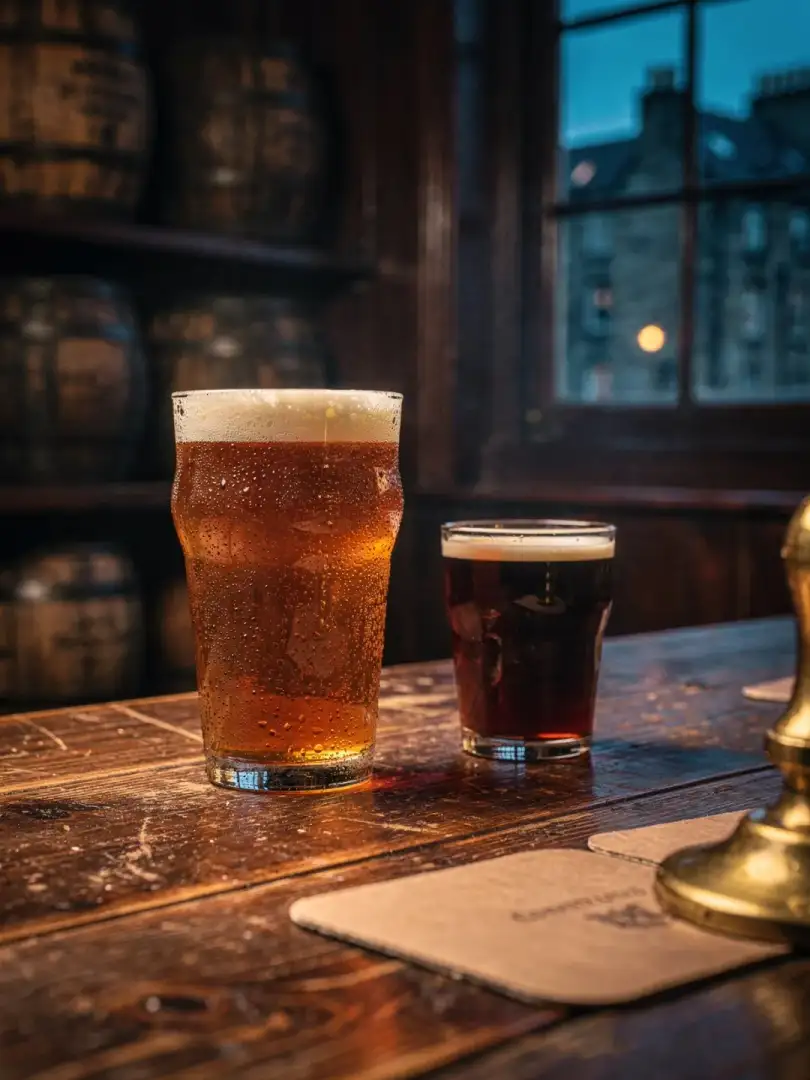
The style behind these numbers is called Scottish Ale, and Belhaven in Dunbar names one of its beers exactly that. It's malty, round, with caramel, toffee and a hint of roast, lightly hopped and sweetish on the finish. Unlike English bitter, where the hops come through more clearly, a Scottish Heavy tastes softer. The Wee Heavy is its strong cousin, with more alcohol, almost liqueur-like character and a long finish.
Scottish Heavytop-fermented
- Original gravity
- 8.8–10 °P
- Alcohol
- 3.3–3.9 % vol
- Bitterness
- 10–20 IBU
- Colour
- 24–39 EBC
Copper-brown, caramel and toffee, light hopping, soft finish.