Goldings & Fuggle
Hops
East Kent Goldings is England's oldest known hop variety. It traces back to the Canterbury Whitebine and was singled out around 1790 by a member of the Golding family. Since 2013, the name has carried PDO protection, making it the first hop variety to receive this status. The cones taste delicately of flowers, honey, and mild citrus, not tropical fruit.
The second major Kent variety is the Fuggle. It traces back to gardener Richard Fuggle of Brenchley, who popularized it in the 19th century. Fuggle tastes earthy, woody, with a hint of mint. Together, these two varieties formed the backbone of English bitters and pale ales for a long time.
How much hop acreage remains in Kent today is far smaller than at the height of cultivation: in the 19th and early 20th centuries, tens of thousands of acres were under cultivation, spread across roughly 300 parishes. Today the area is much smaller, and most hop gardens grow for brewers who specifically request their varieties.
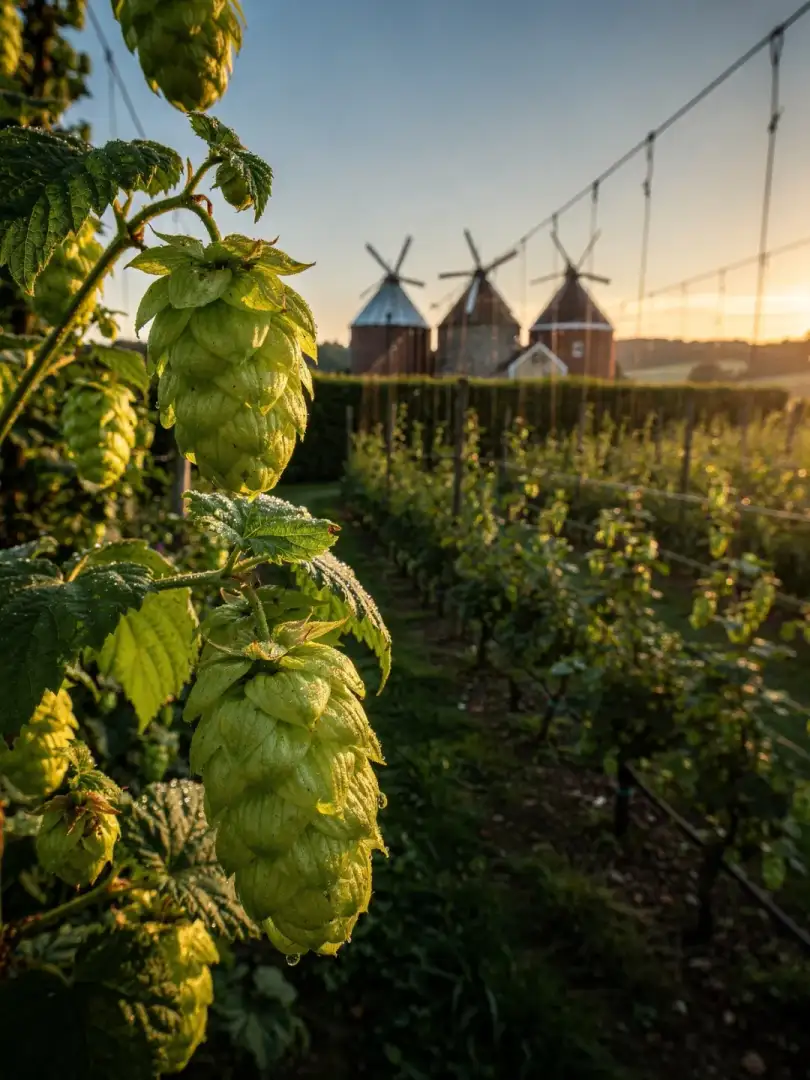
In the hop garden, the plant climbs strings strung from trellises. Harvest comes in early September. It used to be done by hand, with baskets and sacks; today machines handle it. After picking, the hops must dry quickly or they'll spoil. That's what the oast houses were, and still are, for: round brick buildings with conical roofs, where a fire burned below and warm air rose up through the cones.
The image of the rotating white cowls atop the peaks is as much a part of Kent as the English Channel itself. They turned with the wind to keep air flowing through the kiln. Many of these buildings are private homes today. One of the largest clusters stands at Beltring, where the Hop Farm Country Park now occupies an old hop farm.