Porter, Bitter, Brown
Beer Styles
What's the difference between porter and stout? Both are dark, top-fermenting beers, and both originated in London. "Stout" originally just meant "strong," and "Stout Porter" was simply a stronger porter. From this, "stout" eventually emerged as its own term. Ireland, Guinness above all, made the style famous, but didn't invent it. According to the BJCP guidelines, English Porter runs 4 to 5.4% ABV, Irish Stout 3.8 to 5%. With stout, the roasted character is usually more pronounced.
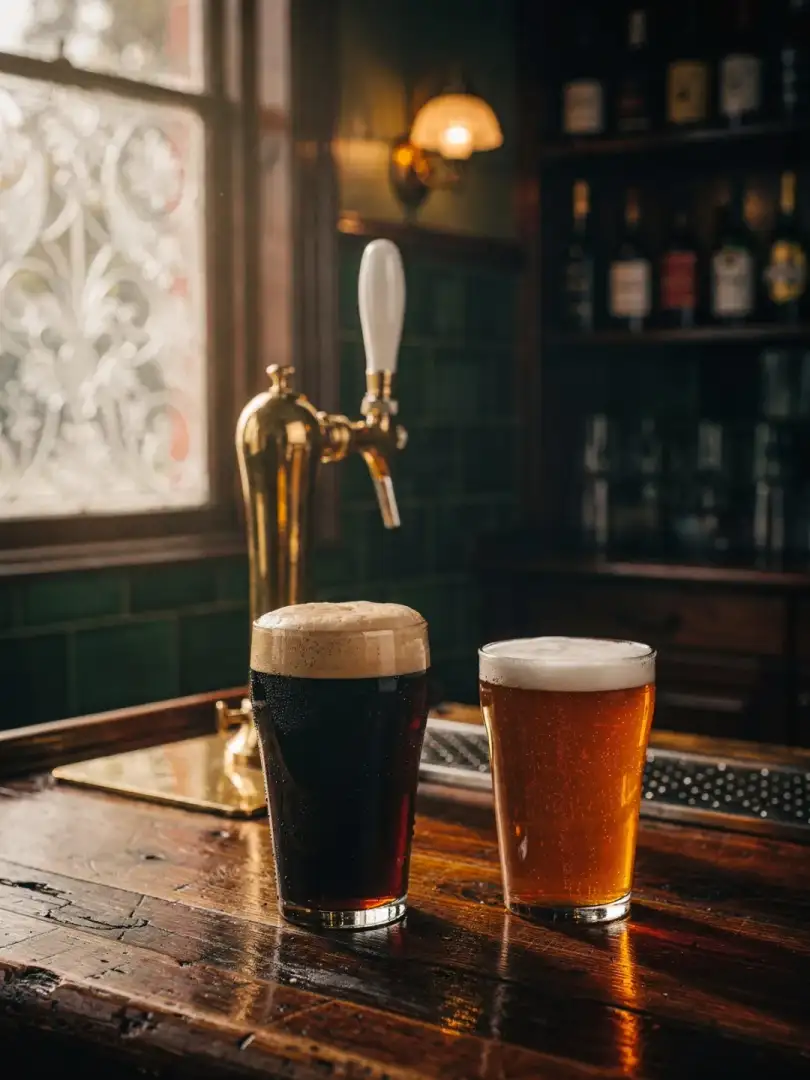
What does a London porter taste like? Of bread crust, toffee, dark chocolate, and a light roasted bitterness, but without the burnt edge of a strong stout. It's dark brown to nearly black, not thick-bodied, and carries a beige head.
Bitter, by contrast, runs copper to golden brown. The name tells you something about its era: compared to the sweeter mild, this more heavily hopped beer was considered bitter. Best Bitter according to BJCP runs 3.8 to 4.6% ABV. It tastes of bread crust, caramel, and mild hops, and suits a long evening at the pub since it isn't heavy. Stronger versions are called Strong Bitter or ESB, short for Extra Special Bitter.
London Brown Ale in its historic form has nearly vanished. The BJCP lists it as a historical style at 2.8 to 3.6% ABV: dark, lightly sweet, and low in alcohol. Mild, also dark and light, is rare today too. Ask for a dark beer at a Fuller's pub and you're more likely to get a porter than a mild, since porter has endured in London. Fuller's London Porter is a good example.
English Portertop-fermented
- Original gravity
- 10–12.9 °P
- Alcohol
- 4–5.4 % vol
- Bitterness
- 18–35 IBU
- Colour
- 39–59 EBC
Dark brown, bread crust and toffee, moderately bitter, without a sharp roasted edge.