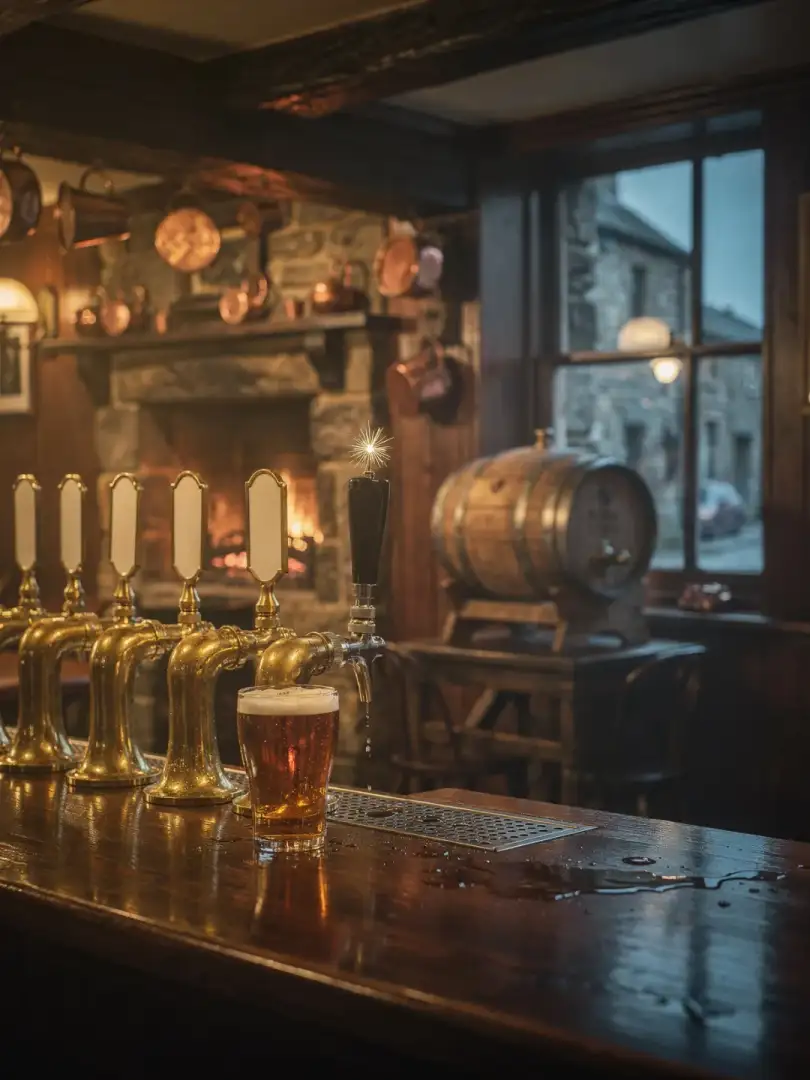
Pint and Handpump
Tasting
How do you drink a Yorkshire bitter? From a pint glass, 568 millilitres, and usually not served ice-cold. In the pub cellar, cask beers typically sit at around 11 to 13 degrees Celsius, noticeably warmer than a pilsner.
The beer comes from the cask via the handpump. The landlord pulls the handle through several times, and the beer flows into the glass without added carbon dioxide. As a result, it foams more softly and has less fizz than a beer from a pressurised tap. Freshly tapped, it's often cloudy; after a few hours the yeast settles and the beer turns clear.
In northern England, many pubs fit a sparkler to the spout, an attachment with small holes that whips the beer into a froth and gives the glass a dense white head. How much foam you like is a matter of taste — and a point of contention between north and south.
You can explore this spectrum with just a few examples. Timothy Taylor Landlord is considered by many to be the benchmark for Yorkshire bitter, Black Sheep Ale comes from Masham, and Theakston Old Peculier shows the dark side. Taste them side by side and you'll see just how far apart a bitter and an old ale can be.
With that first sip, it's worth noting three things. How does it smell — of bread, grass or caramel? How dry is the finish? And how long does the bitterness linger in the mouth? This gives you a feel for the style without having to memorise it.