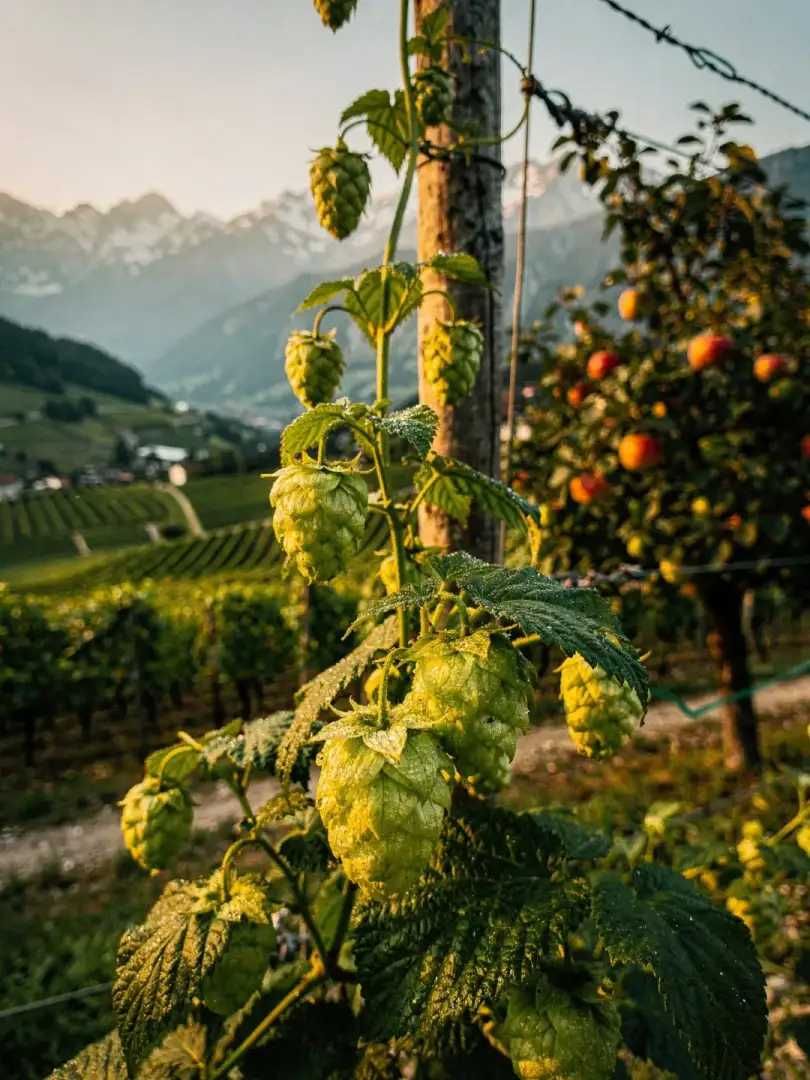
Bitterness and Aroma
Hops
South Tyrol is a land of orchards and vineyards. Apple meadows and vine-covered slopes fill the valleys, and hops aren't among the main crops. The large hop gardens lie elsewhere, and brewers source their hops from there.
What do hops do in beer? They provide two things. Bittering compounds dissolve as the wort—the sweetened liquid made from malt and water—is boiled, balancing out the sweetness. Aromatic compounds are volatile and easily lost, so they're added late in the kettle.
Bitterness is measured in IBU, International Bitterness Units. A Helles sits around 16 to 22, a German Pilsner at 22 to 40, an Export at 20 to 30. The number indicates how many bittering compounds are in the beer, not how bitter it tastes, since a lot of malt sweetness can mask much of it.
One example: Forst V.I.P. Pils is brewed with more hopped wort than an Export, as befits a Pilsner. The Pils is meant to finish dry, its bitterness fading quickly, leaving a clean, slightly bitter aftertaste. An Export, by contrast, retains more malt sweetness, since it's balanced with fewer hops.
Craft breweries go further. Batzen Bräu in Bolzano brews classic styles alongside an IPA generously loaded with aroma hops, which can smell of citrus fruit and resin. By comparison, a lager from the valley seems restrained, and that's exactly what makes it so food-friendly, since it accompanies dishes rather than overpowering them.