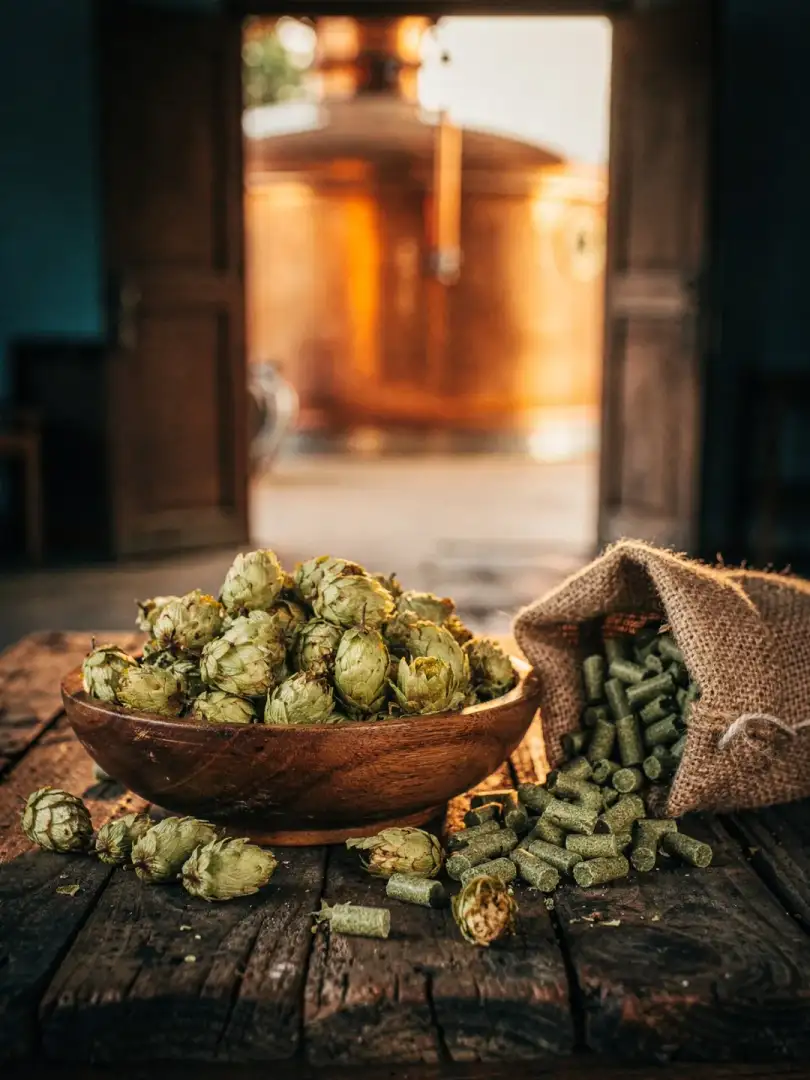
Hops from Germany
Hops
No hops grow in Laos for the brewery. The climbing plant, whose flower cones season the beer, loves the long summer days of temperate zones, and it fares poorly in the tropical lowlands. Lao Brewery sources its hops from Germany, as it does its yeast.
Laos has no access to the sea. Raw materials like hops therefore travel long distances to reach the country, and the beer depends on a long supply chain before the first bottle is filled. Hops usually arrive as pressed pellets, which keep well when stored cool.
Hops do two different jobs. Added early in the boil, they provide bitterness, measured in IBU, International Bitterness Units. Added late, they contribute aroma, scents of grass, flowers or herbs. The bitterness comes from alpha acids, which only become soluble during boiling.
For an international pale lager, the 2021 BJCP guidelines, a US competition rulebook, cite a range of 18 to 25 IBU. For comparison with the hop's homeland: a German Pils sits at 22 to 40 IBU, a Bohemian Pils at 30 to 45. Beerlao Original tastes accordingly soft and restrained.
Then there's temperature, a topic familiar to anyone who's ordered a beer in Vientiane by the Mekong. When a beer is drunk ice-cold, the tongue perceives bitterness more faintly. A lightly hopped lager therefore suits a country where beer is often served over ice in the glass and the hops shouldn't overpower the food.