Kaimiškas, the Village Beer
Beer Styles
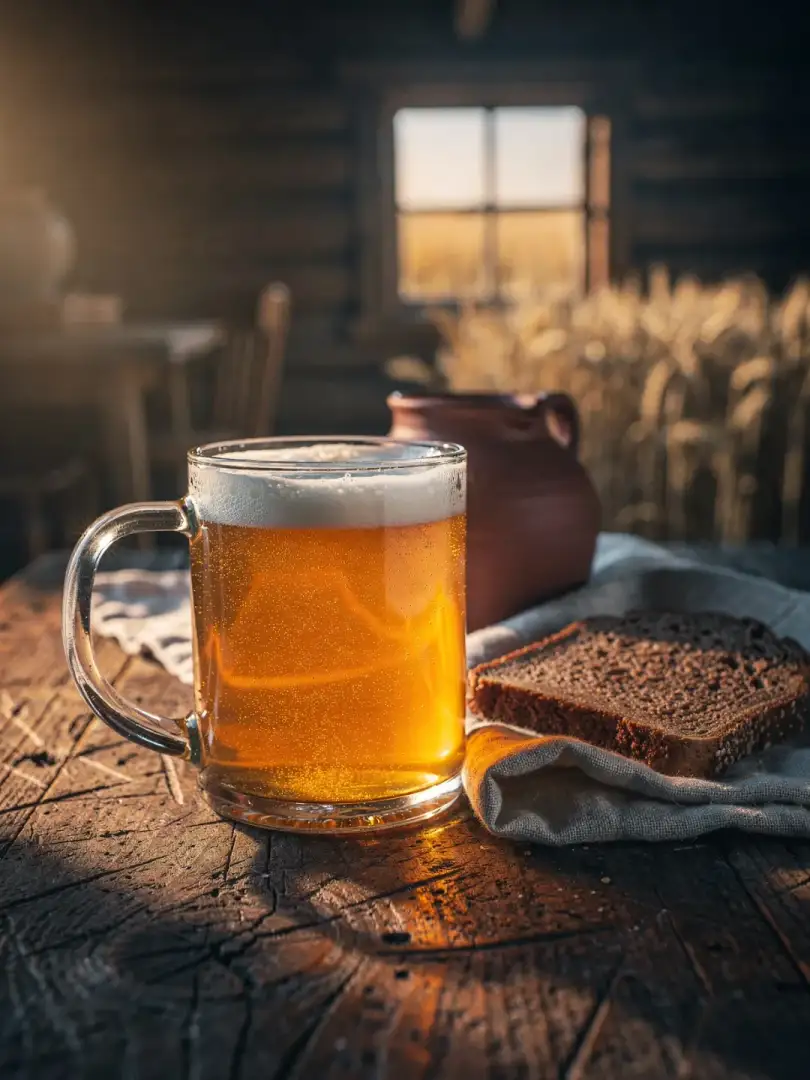
What does Kaimiškas taste like, and how does it differ from an everyday beer? It's cloudy, amber-colored, and unboiled, with aromas of bread, caramel, and fruit. The body feels round despite being dry-fermented, and carbonation is gentle.
It isn't a style in the strict sense. There's no style standard, no competition category, and no fixed recipe—only what families pass down on their farms. Among recognized styles, the closest match is the Belgian saison, another warm-fermented farmhouse beer. That's why the saison's figures appear in the profile as a point of comparison, not as a benchmark.
One beer from the Jovarai family, as measured by Garshol, came to six percent alcohol, with notes of fruit, herbs, and walnut, a hint of phenols and an oily mouthfeel, finishing dry and herbal. The Rinkuškiai brewery near Biržai operates on a larger scale.
The difference from pilsner or helles is fundamental: those are boiled, filtered, and cold-fermented, while this beer is warm-fermented, unboiled, and unfiltered. The difference from hefeweizen lies in the grain and the haze: here, the cloudiness comes from living yeast and protein, not from wheat.
Legally, too, Kaimiškas isn't a term anyone is required to use in a particular way. The PGI applies only to 'Kaimiškas Jovarų alus.' Other brewers also call their farmhouse beer Kaimiškas alus without any seal behind it. Looking at the label, you can only identify the protected name by its full designation.
Kaimiškas alus (comparison style: Saison)top-fermented
- Original gravity
- 11.9–15.9 °P
- Alcohol
- 5–7 % vol
- Bitterness
- 20–35 IBU
- Colour
- 10–28 EBC
Figures from the comparison style, Saison. Kaimiškas has no fixed standard: unboiled, naturally cloudy, dry.