Aroma Over Bitterness
Hops
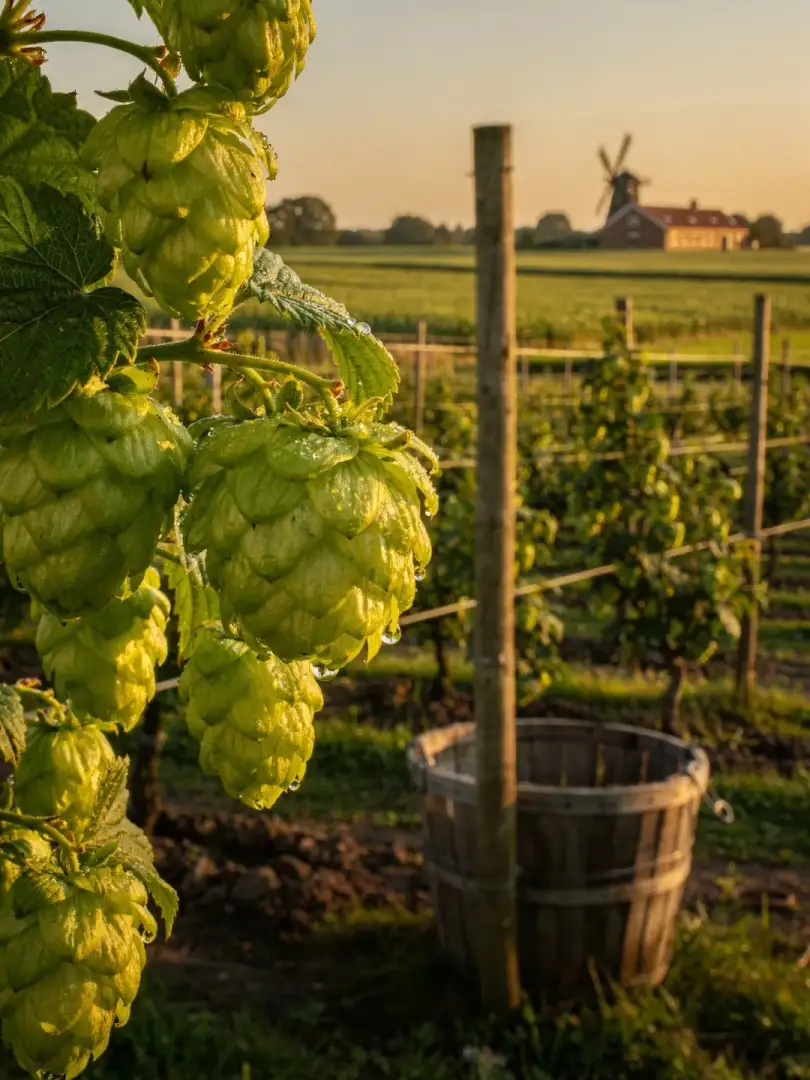
Does hops grow in Holland? Hardly—the climate and soil aren't suited to large hop gardens. But the country discovered hops as a trading commodity early on: around 1300, brewers in Hamburg began using hops, and about twenty years later the Dutch followed suit. Where gruit once had to be bought at a high price, now a stable, bitter-spiced beer could be shipped instead.
Keeping qualities were the real payoff. Hops protect beer, allowing it to survive long voyages across the North Sea and Baltic. This made the brewing towns rich, and it's the reason Haarlem once shipped beer so far afield—something the Jopen brewery still traces today. Hops were thus a piece of foreign trade, long before anyone cared about aromas.
Today, the hops used by the large breweries come from the usual growing regions and are processed into pellets or extract. The goal is a consistent Pils with mild bitterness. For international pale lagers, the BJCP competition guidelines cite roughly 18 to 25 IBU, the measure of bitterness, which puts them well below a robust Pils.
Craft brewers in Amsterdam, by contrast, focus on aroma. They add hops late in the boil or in the fermenter, producing notes of citrus, resin, or blossom without increasing bitterness. Aroma and bitterness are two sides of hops: bitterness comes from long boiling, fragrance from brief contact.
In Bokbier, hops stay in the background, though in recent years some brewers have been dialing up the hopping. That's a trend, not a rule. Anyone tasting a classic Bok should focus first on the malt, then on the bitterness.