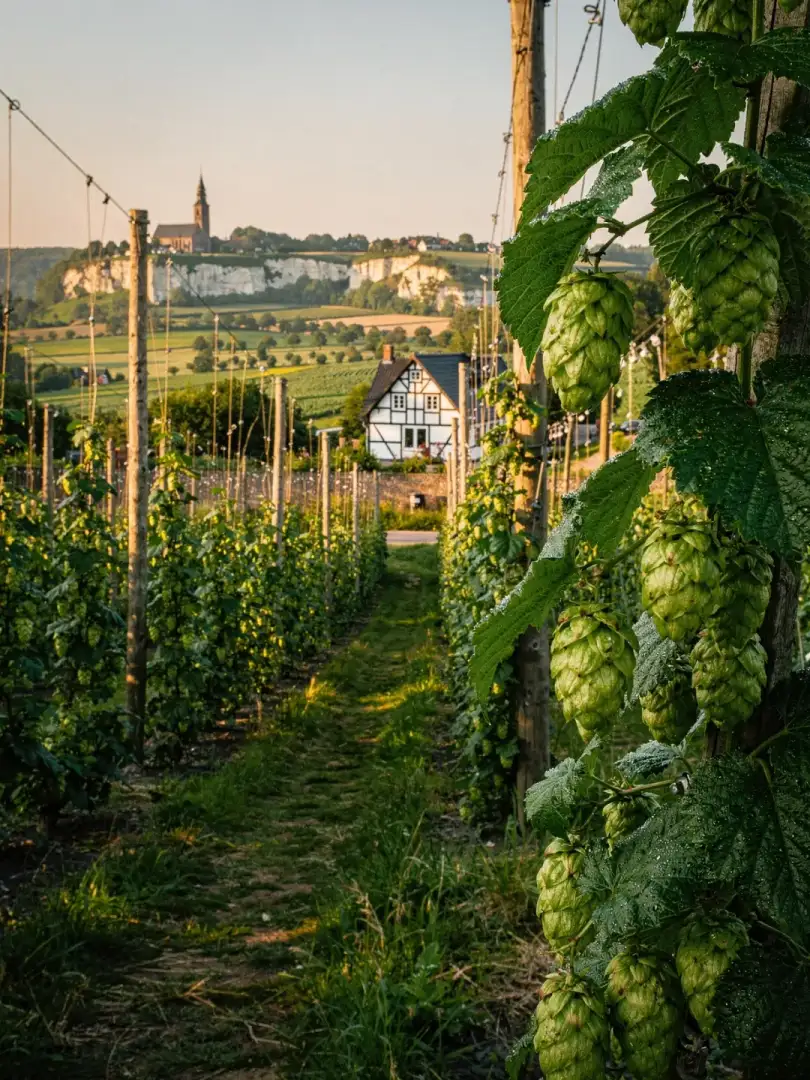
Its Own Hop Garden
Hops
Does hops grow in the Netherlands? Yes, but only on a small scale, and in South Limburg it's more of a curiosity than an industry. Gulpener mentions its own hop garden at the brewery, which supplies part of the cones used in its Bio Pils.
The Brand brewery states that it brews according to the Reinheitsgebot of 1516. This is voluntary, not a legal requirement, since the German purity law doesn't apply in the Netherlands. Hops, barley malt, water and yeast are therefore a house decision, not an obligation.
What's the actual purpose of hops? They make beer bitter and help preserve it, and depending on the variety, they can smell of grass, flowers or citrus. Early additions during the boil bring bitterness, late additions bring aroma. IBU, the bitterness units, measure bitterness numerically—a Pils usually falls between 22 and 40.
With Limburg's Pils, the focus isn't on an aroma bomb but on a fine, floral touch of bitterness. Alfa describes its Edel Pils as based on a first-generation family recipe, without revealing the hop varieties. Ask around in Maastricht or Gulpen, and you'll get answers about the flavor, not the varieties.
Most of the hops used by Limburg's brewers are also bought elsewhere—growing regions like the Hallertau in Bavaria or Poperinge in West Flanders are just a few hours' drive away. The brewery's own hop garden in Gulpen is thus a sign of closeness to the raw material, not a substitute for purchasing it. Visit Wijlre or Thull, and you're more likely to see hops on the label than growing in the field.