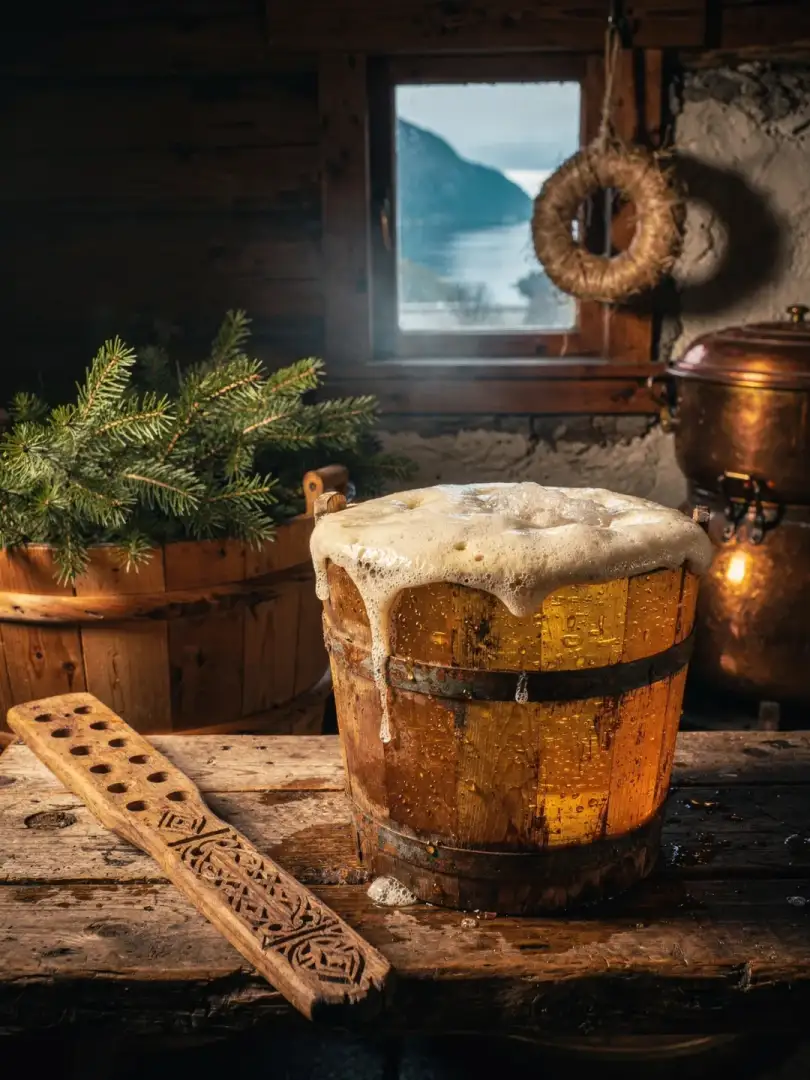
Warm, fast, passed down
Yeast & Fermentation
Why does Kveik ferment so hot? The yeast comes from farms where the wort never had time to cool down first. Brewers in Voss and Hornindal pitch it at temperatures well above 30°C (86°F), conditions under which ordinary brewer's yeast would produce off-flavors. Kveik, by contrast, stays clean and fruity.
Fermentation is correspondingly fast. Where an ale might normally take a week, a Kveik beer is often done within a few days. Worth knowing: Kveik is a top-fermenting yeast, meaning it works at the surface and forms a thick layer of foam there.
What's special is how farmers preserved it. Yeast was kept in a piece of wood called a Kveikstokk or Kveikring. The stick was lowered into the fermenting vessel, the yeast was allowed to cling to it, and then it was dried. One of these wooden sticks bears the date 1621.
Others dried the yeast on rings of straw, on linen cloth, or as flat cakes mixed with flour. Properly dried, it kept for over a year. Neighbors borrowed yeast from one another without payment, keeping it circulating throughout the valley.
Lars Marius Garshol discovered that a single sample often contains three to seven closely related strains. The yeasts from Voss and Hornindal taste different from one another, so brewers name them after their place of origin. Vossaøl is considered especially spicy, with hints of orange peel and Christmas spice.
In Stjørdal, it's often just ordinary baker's yeast that ferments the smoked beer. There, the malt smoke takes center stage, not the yeast. In both worlds, fermentation happens in open wooden or plastic vessels in a warm environment, and aging is practically unheard of.