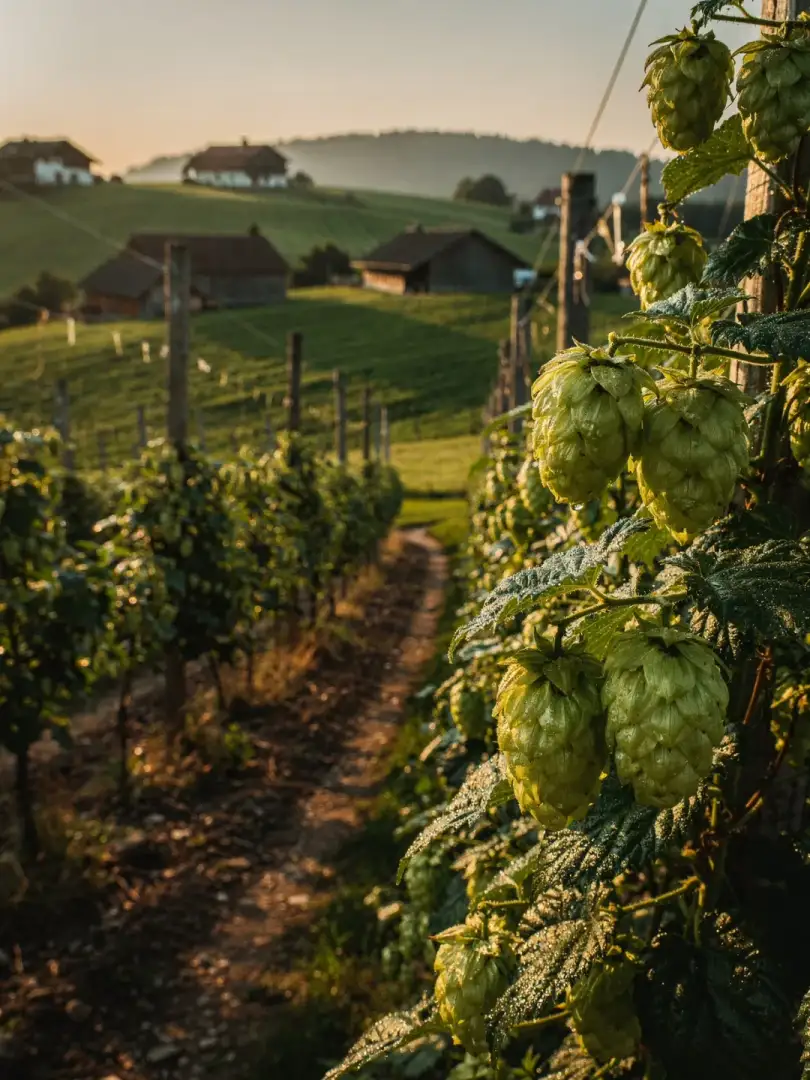
Mühlviertel Cones
Hops
Salzburg's hops don't grow right outside the brewery door. According to the brewery, Stiegl sources its hops from farmers in the Mühlviertel, a hilly region north of the Danube in Upper Austria. The distances are short enough that the cones reach the brewery quickly after the late-summer harvest.
According to the brewery, Trumer uses exclusively natural hops from selected hop farmers. Natural hops means the dried cones or pellets pressed from them—not a chemically derived extract. This gives the pilsner a clean, spicy aroma and a bitterness that fades quickly.
Hops serve two roles in beer. Boiled early in the wort kettle, they release bitter compounds that counter the sweetness of the malt. Added late, or introduced cold, they contribute mainly aroma without adding bitterness. Salzburg's pilsners rely on a balanced measure of both.
That hops have played a role in Salzburg's family histories is clear from a glance at Obertrum: the brewery's buyer, Josef Sigl, came from the hop trade in 1775. Anyone who knew hops knew how to keep a beer stable over time.
The breweries from Maxglan to Obertrum am See buy their hops fresh every year, since hops lose aroma when stored too long in warmth. That's why they're usually kept chilled or stored as pellets before going into the kettle.
As a rough benchmark for bitterness, a German-style pilsner typically falls between 22 and 40 IBU. IBU stands for International Bitterness Units and measures the bitter compounds in beer.