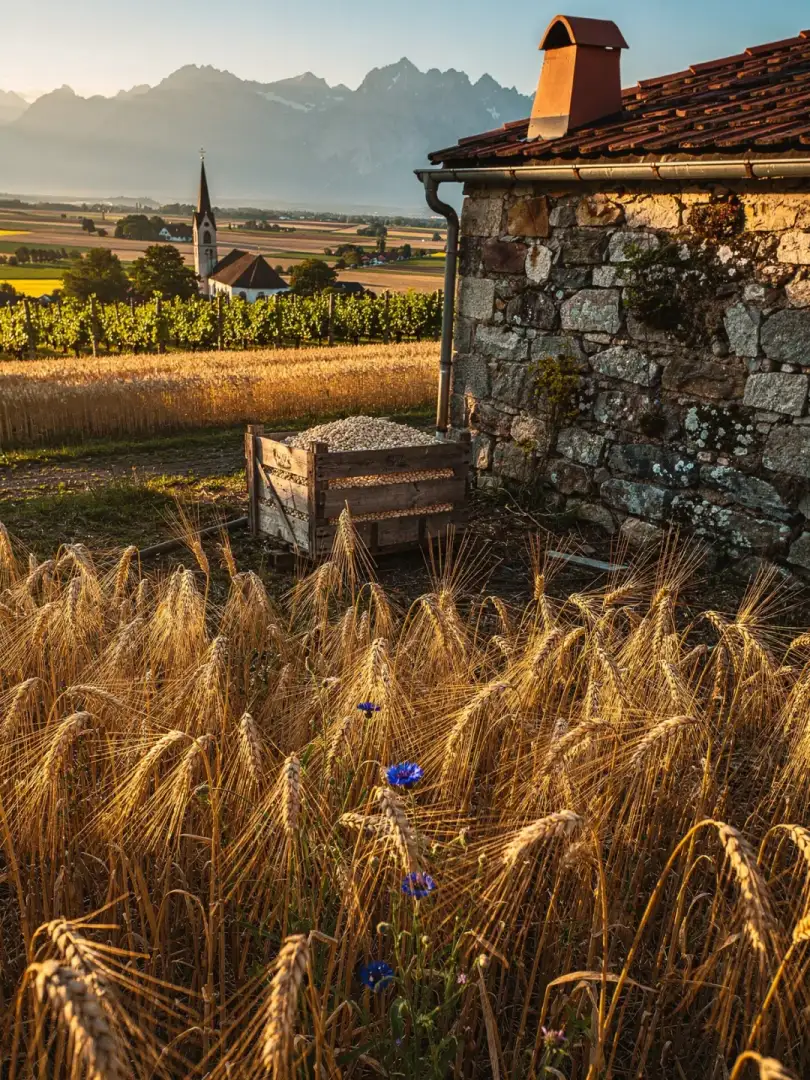
Barley from Lake Constance
Malt & Grain
Barley becomes malt by moistening the grains and letting them germinate, then drying them on the kiln, a heated drying floor. For a pale lager, kilning is done gently so the malt stays light and tastes mildly of bread and biscuit. The more intensely it's roasted, the darker the beer becomes.
Mohrenbrauerei in Dornbirn states that its raw materials come from the region around Lake Constance. So the barley doesn't grow on the steep slopes, but in the flat country where the Rhine and the lake create a mild climate. Here, the Rhine Valley is the breadbasket, and the mountains are the water reservoir.
The Starkenberger brewery also places value on ingredients from local farmers. This fits the self-image of the small Tyrolean operations: they know the farmer who supplies the grain, and they advertise it. How large the share of regional barley actually is, the breweries rarely say.
Fohrenburg invokes the Reinheitsgebot of 1516 and brews with water, hops, and brewing malt. The brewhouse holds up to eight brews of 23,000 liters each. In the brewhouse, the crushed malt is mashed with warm water so the starch converts into sugar, then separated from the spent grain, the leftover husks—a process called lautering.
How strong a beer turns out is indicated by the original gravity: the proportion of dissolved substances from the malt in the wort before fermentation, measured in degrees Plato. The Fohrenburger Jubiläum, a special beer, has an original gravity of 12.8 degrees according to the brewery. More malt in the mash means more sugar, and the yeast later turns that sugar into alcohol.